


Four failure modes, how to tell which one you have, and what to rebuild first.
TL;DR: Low reply rates have four common causes, and each leaves a different fingerprint:
- High acceptance, low replies → the message
- Low acceptance → targeting
- Replies that go nowhere → the offer
- Replies from the wrong people → the ICP
This article covers how to diagnose which failure you have from your own numbers, why token personalization stopped working, and how to rebuild a sequence around account-level signals.
Here's the version of this story we hear most often. A team commits a quarter to LinkedIn outreach. Two SDRs, a Sales Navigator license, a sequence somebody wrote in an afternoon. Twelve weeks later, the reply rate sits at 4%, and when you read the replies, most of them are some variation of "not interested." The conclusion in the next pipeline review writes itself: LinkedIn doesn't work for our market.
It's the wrong conclusion, and the reason it gets reached is that reply rate on its own tells you almost nothing about what went wrong. Two teams can post identical 4% reply rates for completely different reasons — one because they messaged the wrong companies, another because they messaged exactly the right companies with an offer nobody wanted. The fixes point in opposite directions. And the standard response to a disappointing quarter, which is to send more, makes both situations worse rather than better.
So before you rewrite anything, work out which failure you're looking at.
What Do Your Numbers Say Is Broken?
You need two numbers to start: connection acceptance rate, and reply rate among the people who accepted. Benchmark both against 27–28.5% acceptance and 10–11% reply, which comes from platform-wide data across 13.2 million outreach attempts rather than a vendor case study.
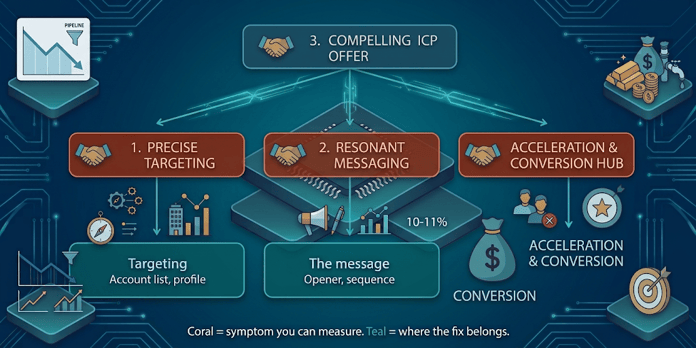
There's a fourth pattern the diagram can't show, because it doesn't appear in either headline number: replies arriving at a healthy rate from people who were never going to buy. That's a list construction problem, and it's the one covered next.
A fifth possibility worth ruling out early — every metric at benchmark and still no pipeline — sits downstream of outreach entirely, in qualification and CRM routing.
|
Signal |
Likely issue |
First fix |
|
Acceptance under 25% |
Targeting, list quality, or weak relevance |
Rebuild account criteria around trigger events |
|
Healthy acceptance, replies under 10% |
Message relevance |
Rewrite the opener around an account-specific insight |
|
Replies arriving, none progressing |
Offer or CTA |
Lower the friction and size the ask to the role |
|
Replies from poor-fit contacts |
ICP construction |
Narrow firmographic and situational filters |
|
Every metric at benchmark, no pipeline |
Qualification and routing |
Audit the SDR-to-CRM handoff |
See also: What Is a Qualified LinkedIn Lead? MQLs, SQLs, and Pipeline Explained
Why Does a Weak ICP Produce Weak Replies?
The mechanism is mechanical rather than mysterious. A broad ICP forces generic messaging, because a message written to work for both a VP of Engineering and a CFO cannot reference anything specific to either. The message ultimately describes your product, since that's the only thing both recipients have in common.
The diagnostic tell: read your outreach and ask whether it could be sent to any company in the vertical without editing a word. If it could, the ICP is doing no work.
A narrow ICP unlocks three things a broad one structurally cannot — pain language the reader recognises as their own, credible references from companies close enough to theirs to matter, and a CTA sized to the authority the reader actually has. A message asking a VP of Engineering to approve a procurement conversation fails not on wording but on premise.
Job title is not an ICP. Two contacts with identical titles at a 20-person startup and a 500-person Series C company are different buyers with different budgets, different problems, and different reasons to reply. What separates a plausible account from a probable one is the situational layer: recent funding, hiring patterns that indicate a build-or-buy decision, a leadership change, or expansion into a market your product supports.
|
Is your outreach creating conversations or just responses? A higher reply rate means little if most replies are “not interested.” Check whether your LinkedIn outreach is producing qualified conversations, referrals, and next steps sales can actually use.
|

Why Has Token Personalization Stopped Working?
Token personalization means merge fields — first name, company name, job title — dropped into a template that says nothing about the account behind them. It reads as personalized for about half a second, which is roughly how long it now survives.
Every contact in a B2B buying role receives several of these a week and recognizes the pattern immediately. The tokens signal effort without demonstrating attention, and the reader has seen the same construction often enough to know what the next sentence will say.
The data supports what the inbox suggests. Connection-note reply rates sit at 3.0% and are declining, while message reply rates hold steady at 10–11% — the format most dependent on token personalization is the only one eroding.
Account-specific personalization requires something different: a recent, verifiable fact about the account, and an explicit connection between that fact and the problem you solve. Nothing more, and no claim to have read something you didn't.
The difference in practice:
- Token: "Hi Sarah, saw you're VP of Marketing at Acme — I work with a lot of marketing leaders at companies like yours."
- Account-specific: "Hi Sarah, saw Acme opened the Berlin office in March. The teams we work with usually hit a reporting problem about two quarters into an EU expansion, when regional pipeline stops rolling up cleanly."
The second one takes four minutes of research and does not scale to 200 messages a day. That constraint is the point. A list of 80 accounts with account-level research outperforms a list of 400 with tokens, and consumes less SDR time in aggregate because the follow-up volume is lower.
See also: LinkedIn B2B Lead Generation for Israeli Tech Companies Selling Globally
How Should an Outreach Sequence Be Built?
Replies concentrate in the follow-ups rather than the opening message, which means a one-message sequence forfeits most of the replies available to it. Sequence structure is worth as much attention as message copy.
Touch 1 — connection request. No note, or a very short one. The note is the weakest-performing element in current data, and a request without one performs at effectively the same acceptance rate.
Touch 2 — after acceptance. Context and relevance, no ask. This is where the account-specific observation belongs.
Touch 3 — value. Something usable without a meeting. A benchmark, a relevant example, a specific observation about their market.
Touch 4 — low-friction CTA. Sized below a 30-minute demo. "Worth a short overview?" converts better than a calendar link at this stage.
Touch 5 — close the loop. Explicit permission to decline. This recovers a meaningful share of replies from people who read earlier messages and didn't respond.
Sequence length should vary by market — US buyers respond to shorter, more direct sequences while EU buyers need a longer warm-up.
Three things to leave out of your messages: links in the first message, which trigger LinkedIn's filters; video before a reply, which asks for more attention than the relationship has earned; and any opener leading with your company, product, or funding round.
Stop after three follow-ups in a cold sequence and move the contact to nurture. Six to eight touches produces blocks rather than meetings.
See also: How Israeli SaaS Companies Can Use LinkedIn to Reach US and EU Buyers
How Do Content, Profile Views, and Messages Work Together?
This is where the largest available lift sits, and it has nothing to do with message copy.
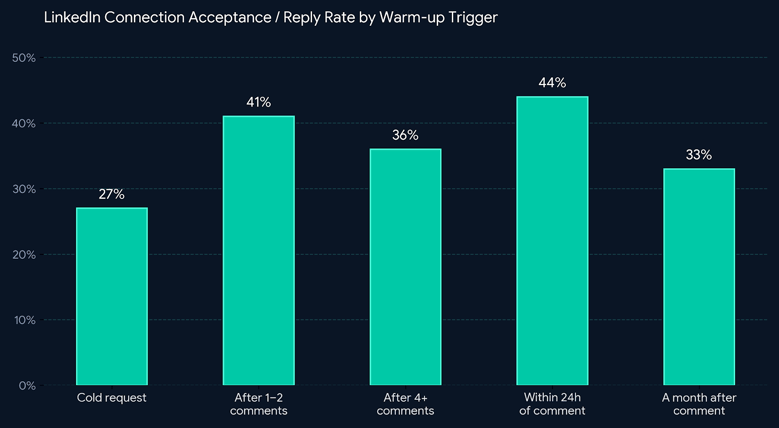
Those numbers come from an analysis of 150,000+ connection requests, 800,000 direct messages, and 850,000 comments. Two things in them deserve attention.
The first is the size of the lift. Commenting once or twice on a prospect's posts before sending the request moves acceptance by 14 percentage points — a larger improvement than any message rewrite reliably delivers. The prospect has seen your name in a professional context before the request arrives, which changes the request from cold to semi-warm.
The second is that both directions have limits. Past four comments, acceptance falls back — sustained attention from a stranger reads as strange rather than familiar. And the effect decays: a request sent within 24 hours of the last comment lands at 44%, while waiting a month drops it to 33%. Warming is a short-lived state, not a permanent status.
The sequence this implies, in order:
- Founder or SDR content published consistently, so a profile check finds a history worth reading
- One or two comments on the target contact's posts, where there's something real to add
- Connection request within 24 hours of the last comment
- Message referencing the exchange rather than a merge field
Profile engagement works as a signal in both directions. InMail sent to someone who has engaged with your content performs 2–3x better than InMail to a cold contact, which makes content engagement one of the more reliable prioritization signals available — and one that most sequences ignore entirely.
See also: How AI is improving B2B prospecting
How Do You Measure Reply Quality Rather Than Reply Rate?
A 15% reply rate composed entirely of "not interested" is worse than an 8% rate producing three qualified conversations. The dashboard shows the opposite, which is why reply rate alone drives sequences in the wrong direction.
Classify every reply weekly into five categories:
- Positive — interest expressed, question asked, or meeting requested
- Referral — wrong person, points to the right one. Counts as a win.
- Deferred — right fit, wrong timing. Belongs in nurture with a trigger date attached.
- Negative — no fit, no interest
- Hostile — annoyed, dismissive, or reporting the message
Positive plus referral above 40% of total replies indicates a healthy sequence. Below that, the composition tells you which failure you have: a high negative share points at ICP definition, a high hostile share points at tone or list source, and a high deferred share points at trigger-event targeting rather than message quality — the contacts are right, the timing is wrong.
Record the classification against the contact record in HubSpot, so it survives the week and can be reported alongside pipeline.
Then ask one question in the weekly review: of last week's positive replies, what did the messages have in common? That question improves sequences faster than any other input available, and it requires the classification to answer.
See also: How to Connect LinkedIn Lead Generation to HubSpot Attribution
Sending More Is the Wrong Response to Every One of These
Outreach failing at 4% and outreach failing at 12% have different causes and opposite fixes, but the instinct in both cases is to increase volume — which compounds a targeting problem, accelerates a tone problem, and burns the account list a second, less receptive time.
Classify last quarter's replies before writing a new sequence. The composition of those replies tells you which of the four failures you're solving, and the fix follows from the diagnosis: rebuild the account list, rewrite the opener, resize the CTA, or warm the contact before the request goes out. Guessing which one costs a quarter. Classifying takes an afternoon.
Key Takeaways
- Reply rate on its own can't tell you what's broken. Check acceptance rate first — under 25% is a targeting problem, normal acceptance with sub-10% replies is a message problem, and the two need opposite fixes.
- Warming beats personalizing, by a wide margin. One or two comments on a prospect's posts lifts acceptance from 27% to 41% — more than any rewrite reliably delivers. Send the request within 24 hours or the effect decays.
- Token personalization is the format that's eroding. Connection-note reply rates sit at 3.0% and falling, while message replies hold at 10–11%. Merge fields signal effort without demonstrating attention.
- Classify replies, don't just count them. A 15% reply rate made up of "not interested" is a worse quarter than 8% producing three real conversations. Positive plus referral above 40% of total replies is the health marker.
|
Are you sending more instead of fixing what’s broken? If LinkedIn outreach is producing low-quality replies, more volume will only burn through the account list faster. A LinkedIn Pipeline Audit helps identify whether the real issue is targeting, message relevance, weak warming, the CTA, or the way replies are handed off to sales.
|