


Counting form fills as leads is why your LinkedIn program looks busy, but your pipeline stays flat. Here's what a qualified lead looks like - and how to track the ones that convert.
TL;DR: A LinkedIn form fill is not a lead. A connection is not a lead. A qualified LinkedIn lead is a contact that matches your ICP, has demonstrated a meaningful intent signal, and has cleared a qualification threshold your sales team has agreed on in advance. This article covers the difference between MQLs, SQLs, and pipeline-ready opportunities on LinkedIn — and how to build the scoring and disqualification criteria that make those distinctions operational in HubSpot.
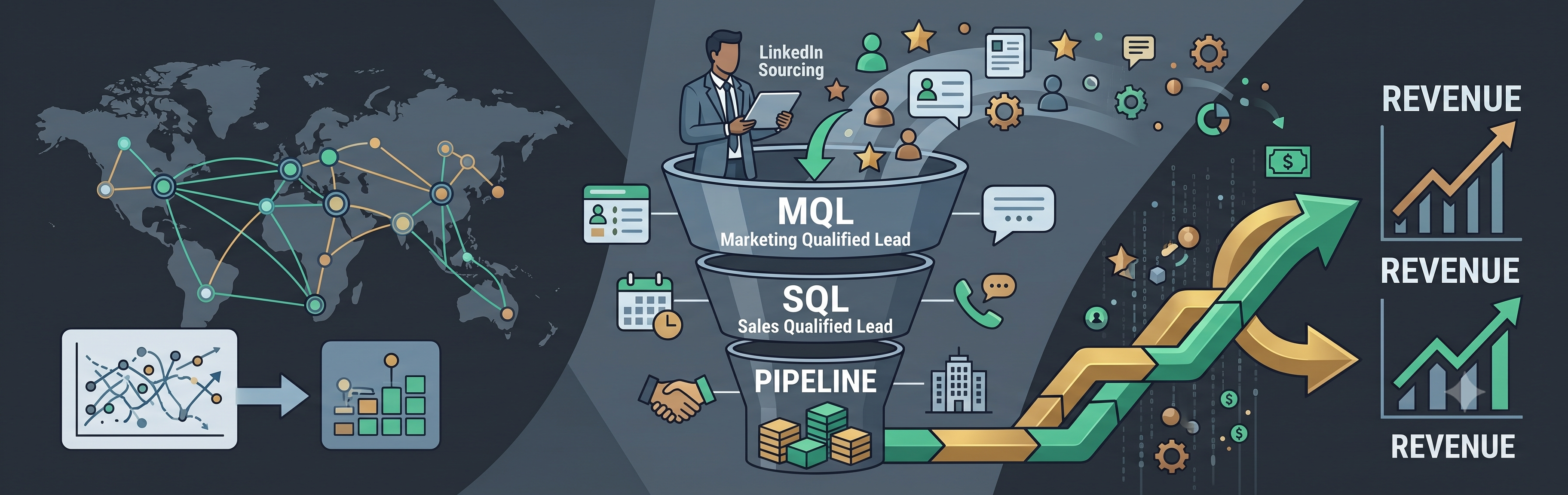
LinkedIn produces higher-quality leads than Google Ads or Meta when measured at the SQL (Sales Qualified Lead) level. The problem is that measurement rarely happens at the SQL level: form fills are counted as leads, MQL (Marketing Qualified Lead) volume is reported upward, and contacts are handed to sales before any real qualification has occurred. Fix the qualification framework, and LinkedIn's conversion advantage shows up in the pipeline review. Leave it broken and the channel takes the blame for a process problem.
What Is Your LinkedIn Program Measuring, and What Is It Costing You?
LinkedIn's MQL-to-SQL conversion rate of 14–18% makes it the quality leader among paid channels - ahead of Google Ads at 7–12% and Meta at 5–10%. However, that advantage only shows up when the MQL definition is enforced. Measure form fills as leads, and the number collapses into noise: SDRs burn time on contacts that were never going to close, sales concludes that LinkedIn generates poor-quality leads, and marketing defends volume numbers that don't translate to pipeline. If your LinkedIn MQL-to-SQL rate is sitting at or below 13%, the first thing to audit is the MQL definition — specifically whether form fills are being passed to sales without clearing ICP fit and intent criteria first.
The root cause is never the channel. It's the absence of a shared, agreed-upon definition of what a lead is between marketing and sales before the program launches. This is a revenue operations problem, and the fix starts with the definition.
See also: LinkedIn B2B Lead Generation for Israeli Tech Companies Selling Globally
Why Is Your Form Fill Volume High but Your Pipeline Empty?
A form fill tells you three things: name, job title, and company. None of those confirm ICP fit, budget authority, active buying intent, or timeline. It tells you someone was interested enough to exchange their contact details for an asset and nothing more.
When form fills are treated as leads, the consequences are predictable. SDRs call every contact regardless of fit; conversion rates look low; sales conclude that marketing is generating poor-quality leads; marketing points to volume; and the cycle repeats every quarter without anyone addressing the root cause.
The distinction worth enforcing: a form fill is the beginning of qualification, not the output of it.
LinkedIn Lead Gen Forms make this problem worse before they make it better. They're high volume and low friction by design — someone can submit their details in two taps on mobile without leaving LinkedIn. That convenience is useful for top-of-funnel reach, but it means intent is lower than a form fill on your own website where someone has actively sought you out. The bar for what counts as a lead from a LinkedIn Lead Gen Form needs to reflect that: a raw form fill should not automatically trigger an SDR sequence.
|
Are your LinkedIn leads sales-ready? Not every form fill deserves SDR time. Audit how your LinkedIn leads are scored, qualified, and routed.
|

LinkedIn MQL vs SQL: What's the Difference and Why Does It Cost You Pipeline?
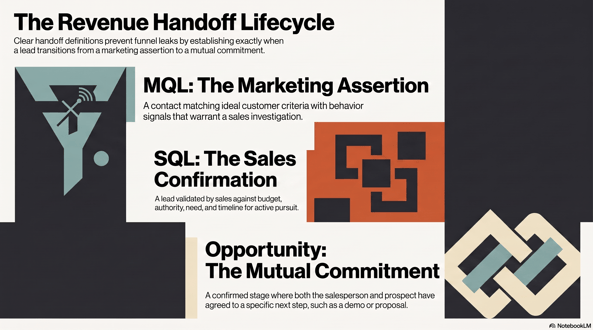
These aren't CRM stage labels. They're handoff agreements between marketing and sales — and when they're not defined clearly and enforced consistently, pipeline attribution breaks down, and neither team can diagnose where the funnel is leaking.
-
MQL: a contact that matches ICP criteria and has demonstrated a behavior signal that justifies sales follow-up. Not a guaranteed fit — a threshold that warrants investigation. The MQL stage is marketing's assertion that this contact is worth a sales rep's time.
-
SQL: a contact that sales has reviewed against defined criteria — budget, authority, need, and timeline — and confirmed is worth active pursuit. This is the stage where a deal should be created in HubSpot. An SQL that doesn't result in a deal being opened is a process failure, not a lead quality failure.
-
Opportunity: an SQL where a specific next step has been agreed with the prospect — a demo booked, a proposal requested, a pilot scoped. A contact becomes an opportunity when there is mutual commitment to a next step, not when the SDR decides they'd like to pursue it.
The steepest drop in the B2B funnel is the MQL-to-SQL transition. The average conversion rate across industries sits at 13%, which means for every 100 contacts marketing hands to sales, 87 go nowhere. If that's where your program sits, the fix is rarely more leads — it's stricter MQL criteria and a defined disqualification protocol that keeps unqualified contacts out of the sales queue before they consume SDR time. The biggest single cause is marketing handing over contacts that sales can't qualify, usually because the MQL definition was set by marketing without sales input.
| Stage | Enter when... | Qualify to next stage when... | Disqualify/move to nurture when... |
| Lead | Form fill, LinkedIn connection, inbound reply | ICP fit confirmed on at least firmographic criteria | No ICP match on company size, industry, or geography |
| MQL | Lead reaches scoring threshold (50+ points) combining fit and engagement signals | Sales confirms budget authority, active need, and timeline | No budget authority, no trigger event, or explicitly not in market |
| SQL | Sales accepts the contact and opens a deal in HubSpot | Specific next step agreed with prospect — demo booked, proposal requested, pilot scoped | No response after defined follow-up sequence, or need confirmed but timeline beyond 6 months |
| Opportunity | Mutual commitment to a next step established | Proposal accepted, legal/procurement engaged, or verbal commitment given | Champion goes dark, budget frozen, or requirement no longer fits your product |
| Nurture | Soft disqualification at any stage | Trigger event occurs — funding, leadership change, expansion signal | No engagement after 90 days — remove from active nurture |
One SLA question every team needs to answer before launching a LinkedIn program: what happens to an MQL within 24 hours of its creation? Following up within the first hour produces a 53% conversion rate. Wait 24 hours, and that drops to 17%. For LinkedIn-sourced MQLs specifically, this means the HubSpot workflow that assigns a contact to an SDR needs to trigger on form fill or scoring threshold — not on a manual review process that runs once a day.
How Do You Know When a LinkedIn Lead Is Ready for Sales?
Sales-readiness is a checklist, not a judgment call. It should be defined and agreed between marketing and sales before the first outreach sequence goes live — not debated retrospectively when a rep complains about lead quality. Four criteria define a sales-ready LinkedIn lead:
ICP fit
Does the contact match the firmographic and situational profile of accounts that have closed before? Company size, industry, tech stack, growth stage, and trigger events — not just job title. A CMO at a 20-person startup is a different contact than a CMO at a 500-person Series C company, even if both replied to the same outreach.
Buying role
Is this person part of the buying committee, or adjacent to it? A VP of Engineering who matches the ICP but has no budget authority needs to be handled differently than a CFO at the same account. Both are worth pursuing — but through different sequences and with different messaging.
Intent signal
What has this person done that indicates active interest rather than passive consumption? Replying to outreach, filling in a form, requesting more information, or engaging with multiple pieces of content within a short window all indicate a different level of intent than a single post like.
Timing
Is there a trigger event that suggests the account is in or approaching an active buying cycle? Recent funding, a leadership change, expansion into a new market, or a public statement about a problem your product solves all indicate an account is more likely to be in motion.
A contact that meets all four criteria warrants an SDR call. A contact that meets two or three belongs in nurture until the remaining criteria are met.
|
Are LinkedIn leads reaching sales before they’re actually qualified? Review whether your LinkedIn scoring, MQL threshold, and handoff rules are filtering for ICP fit, intent, and buying role before contacts enter active follow-up.
|
Why Are Bad Leads Sitting in Your Pipeline — and What Should You Do With Them?
Most qualification frameworks define what makes a lead good. Fewer define what makes a lead dead — which means disqualified contacts accumulate in the pipeline, inflate stage counts, distort conversion metrics, and waste sales time on opportunities that were never real.
Disqualification criteria need to be as explicit as qualification criteria, and enforced with the same discipline. A contact that doesn't meet the threshold should be removed from the active pipeline immediately.
Hard disqualification — remove from pipeline, do not nurture:
-
Company size or industry sits outside ICP definition
-
No budget authority and no identified path to the budget owner at the account
-
Competitor, agency, student, or job seeker
-
Geography outside defined target markets
Soft disqualification — move to nurture, revisit on trigger event:
-
ICP fit confirmed but no active trigger event suggesting a buying cycle
-
Right company, wrong contact — matches the account but not a buying committee role
- Engaged with content or replied to outreach but explicitly indicated no current need
The operational cost of skipping this step is significant. Sales time spent on contacts that were never going to convert is the most expensive line item in a LinkedIn program — and the hardest to see because it doesn't show up in CPL or MQL volume reports. It shows up in sales cycle length, SDR capacity, and close rate. Defining disqualification criteria and enforcing them in HubSpot is how you recover that time and redirect it to contacts worth pursuing.
See also: LinkedIn Ads vs. Sales Navigator vs. Organic LinkedIn: Which Works Best for B2B Lead Generation?
How to Build a LinkedIn Lead Qualification Framework in HubSpot
The operational cost of skipping this step is significant. Sales time spent on contacts that were never going to convert is the most expensive line item in a LinkedIn program — and the hardest to see because it doesn't show up in CPL or MQL volume reports. It shows up in sales cycle length, SDR capacity, and close rate.
Defining disqualification criteria and enforcing them in HubSpot is how you recover that time and redirect it to contacts worth pursuing.
| Signal | Type | Score |
| Company size matches ICP | Fit | +10 |
| Industry matches ICP | Fit | +10 |
| Job title confirms buying committee role | Fit | +10 |
| Geography matches target market | Fit | +10 |
| Tech stack confirmed match | Fit | +10 |
| LinkedIn Lead Gen Form fill | Engagement | +20 |
| Replied to Sales Navigator outreach | Engagement | +25 |
| Visited pricing page | Engagement | +20 |
| Engaged with 3+ pieces of content in 30 days | Engagement | +15 |
| Booked a meeting | Engagement | +40 |
Set the MQL threshold at 50 combined points. Contacts that reach it are automatically moved to MQL stage in HubSpot and assigned to an SDR for follow-up within 24 hours. Contacts below the threshold stay in nurture and are re-evaluated as engagement signals update.
Two HubSpot setup requirements that determine whether this works in practice: LinkedIn Lead Gen Forms must be synced natively to HubSpot so form fills create contacts automatically and trigger scoring. UTM parameters must be consistent across all LinkedIn campaigns so every contact can be attributed to the specific campaign, audience, and creative that generated them.
B2B SaaS companies using behavioral scoring models aligned to SQL criteria achieve 39–40% MQL-to-SQL conversion rates — three times the 13% industry average — without generating more leads or increasing budget. If your current rate is below 20%, the scoring model is the starting point — specifically whether engagement signals like Sales Navigator replies and pricing page visits are weighted above passive signals like a single content download. The difference is entirely in how the model is built and what signals it weights.
Which Metrics Tell You If Your LinkedIn Qualification Framework Is Working?
Volume metrics tell you the top of the funnel is moving. They don't tell you whether the qualification framework is doing its job. For that, you need conversion metrics tracked at every stage and reviewed on a defined cadence with sales.
-
MQL-to-SQL rate: what percentage of contacts marketing hands to sales are confirmed as sales-qualified? The B2B average is 13%. Top-performing teams with tight behavioral scoring hit 30–40%. A rate below 20% on LinkedIn-sourced leads suggests the MQL definition is too loose — contacts are being passed before they've cleared the qualification bar.
-
SQL-to-opportunity rate: what percentage of SQLs result in a booked meeting or active deal? The B2B benchmark is 10–12%. Below that, either the SQL definition needs tightening or the SDR follow-up process is breaking down between handoff and first contact.
-
Demo rate: of contacts that reach a booked meeting, what percentage show up and engage meaningfully? Low demo rates indicate a contact that looked qualified on paper but had low genuine intent — often a symptom of over-reliance on form fills as a qualification signal.
-
Pipeline created (attributed to LinkedIn): total value of opportunities created from LinkedIn-sourced contacts, tracked in HubSpot by source and campaign. This is the metric that belongs in a board review — not CPL, not MQL volume.
The framing that clarifies budget allocation: a channel that costs $50 per MQL but converts at 10% to SQL has a real cost of $500 per SQL. A channel that costs $200 per MQL but converts at 50% has a real cost of $400 per SQL. The second channel is more efficient — but under an MQL-volume framework it looks four times more expensive. Cost per SQL is the metric that makes LinkedIn's quality advantage visible.
Review MQL-to-SQL and SQL-to-opportunity rates weekly with sales. Review pipeline created monthly with leadership on a 90-day rolling basis to account for LinkedIn's longer lead-to-opportunity cycle. A persistent red flag: high MQL volume with a low SQL rate almost always means the MQL definition was written by marketing without sales input.
See also: How Israeli SaaS Companies Can Use LinkedIn to Reach US and EU Buyers
Stop Measuring LinkedIn by the Wrong Number
Most LinkedIn programs that "don't work" are working fine — they're just being measured by metrics that can't capture the value they're producing. Form fill volume looks low compared to Meta. CPL looks high compared to Google. Neither comparison accounts for the fact that LinkedIn-sourced leads convert to SQL at 14–18%, while Meta sits at 5–10%.
The qualification framework determines whether those conversion rates show up in your pipeline reports or disappear into a spreadsheet nobody looks at. Tighten the definition, enforce the criteria, and measure cost per SQL instead of cost per lead. Everything downstream of those three changes improves.
Key Takeaways
-
LinkedIn's quality advantage only shows up when the MQL definition is enforced. Measure form fills as leads and a 14–18% MQL-to-SQL conversion rate collapses into volume numbers that mean nothing.
-
A form fill is the beginning of qualification, not the output of it. A raw LinkedIn Lead Gen Form fill should never automatically trigger an SDR sequence.
-
Disqualification criteria are as important as qualification criteria. Bad leads sitting in the pipeline don't show up in CPL reports — they show up in sales cycle length and close rate.
-
Cost per SQL, not cost per lead, is the metric that tells you whether LinkedIn is working. A channel that costs $200 per MQL but converts at 50% to SQL is more efficient than one that costs $50 per MQL but converts at 10% — even though it looks four times more expensive.
|
Find out why LinkedIn leads are not becoming SQLs LinkedIn can produce strong-fit opportunities, but only when the scoring, qualification criteria, disqualification rules, and sales handoff are built properly. Review the full path from form fill to pipeline and see what needs to change first.
|