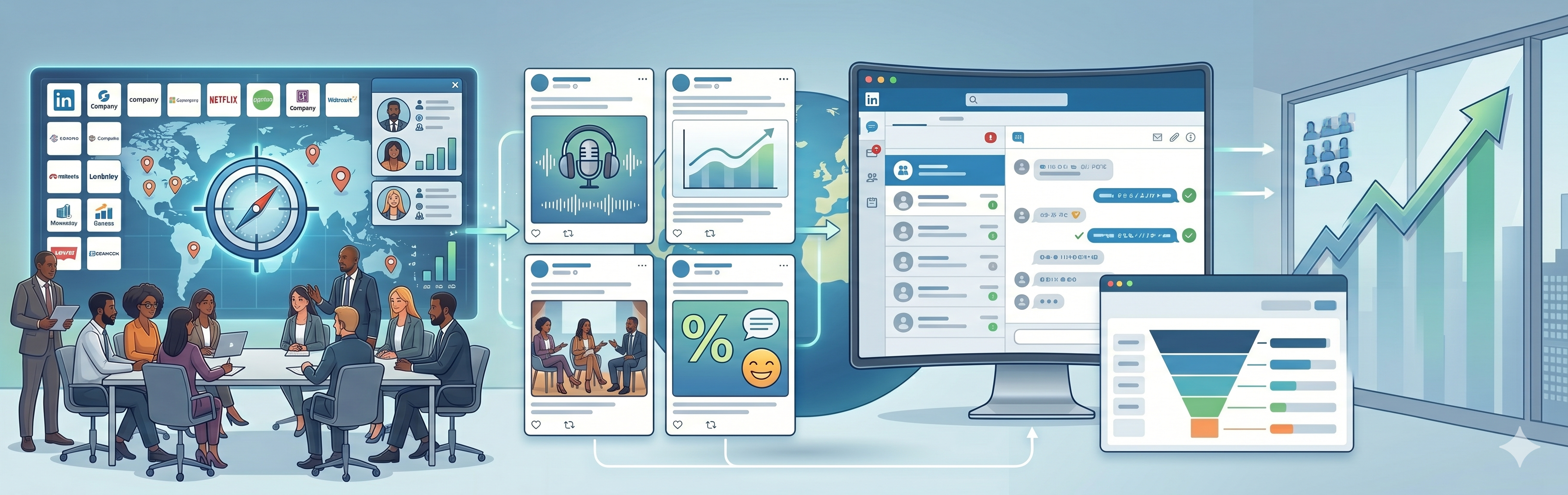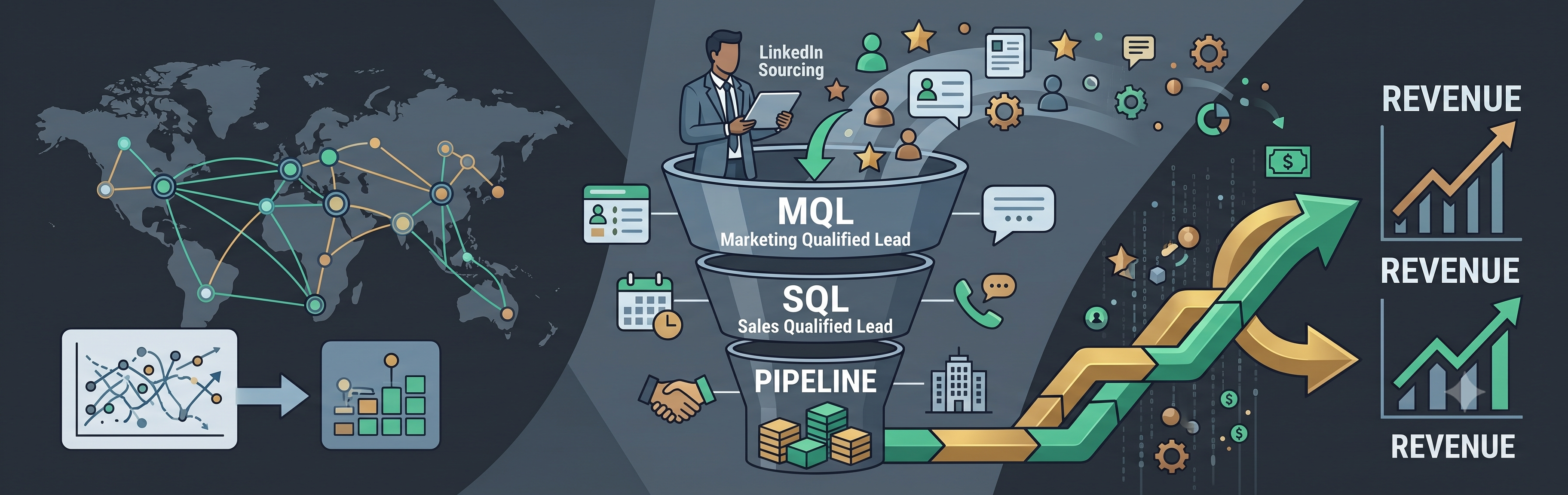


Which LinkedIn motion fits your stage, budget, and sales cycle — and what to run next once it's working.
TL;DR: LinkedIn Ads need proof points to amplify. Sales Navigator needs a defined ICP to produce replies. Organic content needs 90+ days before it moves pipeline. Most programs fail not because LinkedIn doesn't work, but because the wrong motion is running at the wrong stage. This article tells you which one fits where you are now — and what to layer in next.
LinkedIn generates roughly 80% of all B2B leads produced through social media — but that number hides a costly assumption. Many teams pour budget into LinkedIn Ads before they have a single proof point to amplify, or run outreach with no defined ICP (Ideal Customer Profile), and conclude the channel "doesn't convert." LinkedIn's targeting can produce a 28% lower cost per qualified lead than Google Ads for B2B — but only when the audience and message have already been validated elsewhere.
The channel isn't the variable that's failing. The sequence is. This article breaks down what each motion — Ads, Sales Navigator, and organic content — is good for, when each is the right starting point, and how to build a sequence that compounds rather than competing for the same budget.
Why This Decision Is Harder Than It Looks
Many marketing teams default to whichever motion a competitor is visibly using, or whichever a vendor is selling them. Neither of those is a strategy — they're just borrowed decisions that may not fit your stage, budget, or sales cycle.
The three motions have fundamentally different cost structures, time-to-result, and skill requirements. Treating them as interchangeable is the most common reason LinkedIn budgets get wasted: a company spends on ads before it has proof points to amplify, or expects content to generate pipeline in week three, or runs outreach with no defined ICP and concludes that "LinkedIn doesn't work for us."
The right starting point depends on three variables:
-
Company stage — do you have proof points yet (case studies, recognizable customers, validated messaging)
-
Budget — can you sustain ad spend through a learning curve, or do you need a pipeline now with limited cash?
-
Sales cycle length — does your buyer make fast decisions, or does trust need to be built over months?
See also: LinkedIn B2B Lead Generation for Israeli Tech Companies Selling Globally
When LinkedIn Ads Work Best
LinkedIn Ads are the amplification motion — they work best for companies that already have proof points and budget to sustain a learning period. Ads amplify what's already working. They don't create credibility from zero.
LinkedIn's targeting precision produces a 28% lower cost per qualified lead than Google Ads for B2B campaigns, yes, but that efficiency only shows up when the audience and message have already been validated. Run ads with an unproven message into a cold audience, and that targeting precision just means you're efficiently reaching the wrong people with the wrong pitch.
Ads work well for:
-
Retargeting audiences that have already engaged with organic content
-
Scaling reach into named accounts as part of an ABM program
-
Supporting product launches or category creation moments, where awareness matters more than immediate conversion
Ads work poorly for:
- Introducing an unknown brand cold into a market — high cost per lead (CPL), low conversion, no existing trust to leverage
- LinkedIn ad spend that produces meaningful data typically requires a multi-month commitment. Teams that test for two weeks and pull the budget when CPL looks high never get past the learning phase — they're judging a motion before it's had time to work.
Ads are the fastest of the three motions to generate volume, and the slowest to generate a qualified pipeline if targeting isn't precise.
|
Not Sure If You're Even Ready for LinkedIn Ads Yet? Running paid before you have proof points wastes budget on a problem that outreach could solve for free. Find out what stage you're actually at.
|

When Sales Navigator Outreach Works Best
Sales Navigator is the validation motion. It's best suited to companies that need a direct pipeline now, have a defined ICP (even if that ICP hasn't been tested yet), and have the headcount to run outreach consistently.
This is where messaging gets validated before it's scaled. Sales Navigator tells you what resonates before you spend your ad budget, so you don't find out the expensive way.
Works well for:
-
Account-based prospecting into named accounts
-
Multi-threading in buying committees
-
Early-stage companies that need a pipeline before they have the proof points ads require
Works poorly for:
- Teams without a clear ICP. Sales Navigator amplifies targeting precision, but it doesn't create it. Broad, unfocused outreach produces low reply rates regardless of how good the message is.
- Outreach quality depends on consistency and message iteration. A part-time effort with no feedback loop on what's working — no one reviewing reply rates, no one adjusting the message — produces mediocre results, no matter how good the targeting is underneath it.
Sales Navigator might be slower to scale than ads, but for companies with the right ICP, it produces the fastest qualified pipeline relative to spend among the three motions.
See also: How Israeli SaaS Companies Can Use LinkedIn to Reach US and EU Buyers
When Organic Founder or Company Content Works Best
Organic content is the credibility motion — best suited to companies in markets where they're unknown and need to build trust before outreach or ads will convert. It's the long-term compounding asset in the system.
Personal profiles generate 5–8x more engagement than company pages, because LinkedIn's algorithm distributes personal content through social graphs and interest signals rather than just to existing followers. Founder content reaches decision-makers in a way that company pages structurally can't.
The 2024 Edelman-LinkedIn B2B Thought Leadership Impact Report backs this up directly: 75% of decision-makers consider thought leadership a more trustworthy basis to assess a vendor's capabilities than marketing materials or product sheets, and 60% say a single piece of thought leadership prompted them to research a vendor they weren't previously considering.
Works well for:
-
Building the credibility infrastructure that makes Sales Navigator and ads more effective
-
Companies where a founder or senior leader is willing to post consistently
Works poorly for:
-
Companies expecting an immediate pipeline. Content compounds over 90+ days — it's not a short-term lead generation lever.
Organic content is the cheapest motion in budget terms and the most expensive in time and consistency. And most programs don't fail because the strategy is wrong, but because posting stops after a month.
How the Three Motions Support Each Other
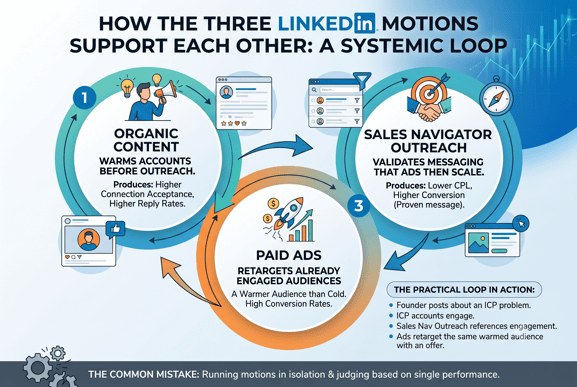
These motions aren't sequential phases you graduate through. They're a system, and each one makes the others more effective.
-
Organic content warms accounts before outreach lands, producing higher connection acceptance rates and higher reply rates
-
Sales Navigator outreach validates the messaging that ads then scale, producing lower CPL and higher conversion because the message is already proven
-
Ads retarget audiences that have already engaged with organic content — a warmer audience than cold targeting, with conversion rates to match
Here's what that loop looks like in practice. A founder posts about a specific problem their ICP faces. Accounts that match the ICP engage with the post. Sales Navigator outreach to those same accounts references that engagement directly — "saw you engaged with a post on X, curious how you're thinking about it." Ads then retarget that same warmed audience with a related offer.
The mistake many marketing teams make is running a single motion in isolation and judging LinkedIn's effectiveness based on that motion's performance — pulling ad budget because CPL looks high in month one, without recognizing that the audience hasn't been warmed yet.
See also: How AI Improves B2B Prospecting
Decision Framework by Company Stage
| Motion | Best for | Worst for | Time to impact | Budget need |
| LinkedIn Ads | Scaling proven offers to known ICP | Cold market, unknown brand | Medium | Medium–High |
| Sales Navigator | Validating messaging, direct pipeline | No clear ICP or offer | Fast | Low (tool + SDR) |
| Organic (founder) | Building credibility and awareness | Teams needing pipeline this month | Slow (90+ days) | Time, not cash |
Pre-product-market-fit / no case studies yet
Start with organic founder content plus manual Sales Navigator outreach. There are no proof points yet for ads to amplify, so ad spend at this stage is largely wasted. Outreach generates a near-term pipeline and surfaces what messaging resonates. Content builds the credibility infrastructure you'll need at the next stage. Avoid ads entirely here — there's nothing yet for them to scale.
Early traction / 2–3 reference customers
Sales Navigator outreach becomes the primary motion, with organic content running in parallel. You now have enough social proof to validate your messaging at scale, while content continues to compound in the background. This is the stage to consider small-budget ad tests — not to generate volume yet, but to start building the data LinkedIn's algorithm needs to optimize delivery.
Scaling / dedicated SDR function
All three motions run in coordination, organized around named accounts. Sufficient proof points and budget now exist to run ads effectively. Outreach is multi-threaded into buying committees rather than single contacts. Content supports both: warming accounts for outreach and providing creative for ads.
Established brand / known in the target market
Ads and organic carry the reach and category positioning load, while outreach narrows to the highest-value accounts only. The credibility infrastructure already exists, so the constraint shifts from "will they trust us" to "are we reaching the right accounts with the right offer at the right time."
The Mistake That Undermines All Three: Choosing a Channel Before Defining ICP and Offer
None of the three motions fix a fundamental targeting or offer problem. They amplify whatever is already true about your positioning — for better or worse.
The symptoms are consistent across companies: high activity — regular posts, steady connection requests, active ad spend — paired with low pipeline. Teams conclude "LinkedIn doesn't work for us" when the actual issue sits upstream of all three motions.
ICP definition and offer clarity have to come first. Every motion's effectiveness is downstream of those two things — a well-run outreach sequence to the wrong accounts still produces low reply rates, and a well-designed ad campaign promoting a vague offer still produces high CPL.
If you can't articulate which specific accounts and roles you're targeting, and what specific outcome your offer delivers for them, no LinkedIn motion will outperform.
See also: Close More Deals With AI-Driven Lead-to-Opportunity Scoring
The Right Motion Is a Moving Target, Not a Fixed Choice
Most LinkedIn programs don't fail because the channel doesn't work. They fail because the sequence is wrong — ads running before there's anything to validate them, outreach going out to accounts that haven't been defined, content posted twice and abandoned when pipeline doesn't materialize in week four.
Pick the motion that matches where you actually are. If you don't have case studies yet, outreach and content come first. If outreach is producing replies but you're struggling to scale, that's when ads earn their budget. Add the next motion only once the current one is producing a signal worth amplifying — not because a competitor is running it or because a vendor is selling it.
Key Takeaways
-
The motion you should run depends on your stage, not your preference. Companies still working toward product-market fit (no established customer base or case studies yet) need outreach and content to generate proof points; ads only work once those proof points exist to amplify.
-
Sales Navigator is the validation layer that ads depend on. Outreach tells you what messaging resonates before you spend ad budget finding out the expensive way — skipping this step is the most common reason CPL looks high.
-
The three motions compound when sequenced correctly. Organic content warms accounts, outreach converts warmed accounts, ads retarget engaged audiences — each motion makes the next one more effective.
-
No motion fixes a bad ICP or vague offer. High activity with low pipeline is almost always a targeting or positioning problem upstream — not a channel problem.
Not sure if your LinkedIn program is working — or just busy? Run through these before changing anything. If two or more apply, the motion is wrong for the stage, not the channel.
-
No case studies or recognizable customers yet, but running ads → you're paying to amplify nothing
-
Outreach reply rate below 10% with no message iteration in the last 30 days → messaging problem, not a targeting problem
-
Ad CPL above $150 with zero SQLs in 90 days → audience is right, offer isn't converting
-
Organic content running for 60+ days with no improvement in outreach acceptance rates → content and outreach aren't targeting the same accounts
|
Spending on LinkedIn Ads With Nothing to Show for It? High CPL is often a symptom of an unvalidated message, not a targeting problem. Find out what's actually driving your cost per lead.
|