




Most B2B prospecting fails quietly. Teams hit activity targets, dashboards look healthy, pipelines appear full. And yet deals stall.
What’s changed isn’t effort or intent - it’s the signal-to-noise ratio. Buying decisions now leave fragmented traces across tools, platforms, and behaviors that humans can’t realistically track in real time. That gap is already separating teams that adapt from those who don’t. Bain & Company found that early AI deployments in sales have increased win rates by more than 30% by being far more selective about where effort goes.
The old model, however, still dominates: define an ICP once, buy a list, research accounts manually, repeat. It looks rigorous, but it freezes reality at a moment in time. Markets move. Priorities shift. Buying groups change. Static targeting and one-off research can’t keep up, and prospecting decisions age badly as a result.
AI changes prospecting by shifting the question from “How many accounts can we reach?” to “Which accounts are actually worth our attention right now?”
What AI Prospecting Actually Is (and Isn’t)
AI prospecting gets misunderstood because it’s often framed as either a silver bullet or just another layer of automation. In reality, it sits somewhere in between, and its value has far more to do with decision quality than output volume.
The simplest way to think about it: AI prospecting doesn’t do the work for you. It helps you decide where your effort actually belongs.
AI as augmentation, not replacement
AI works best when it narrows the field before humans engage. Instead of starting with hundreds of “potential” accounts, teams begin with a much smaller set that already shows stronger signals of relevance or readiness.
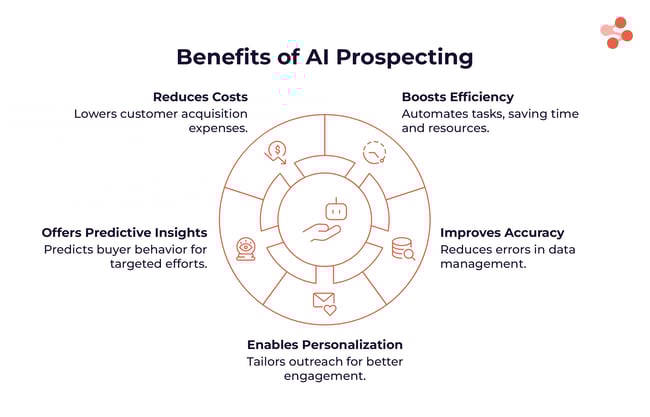
Image source: SMARTe
Humans still do the work that matters most: interpreting nuance, shaping messaging, and making commercial judgment calls. What AI removes is the early-stage noise that forces teams to spread attention thin across too many accounts.
Automation vs. intelligence in prospecting
This distinction is easy to miss but critical in practice.
Automation follows rules you define. Intelligence adapts based on outcomes.
Most prospecting stacks already automate activity: enrichment, sequencing, routing. AI prospecting goes further by learning from what actually happens downstream - which accounts progress, which stall, and which convert efficiently. If prioritisation doesn’t improve over time, you’re not benefiting from intelligence; you’re just accelerating existing assumptions.
Why signal quality matters more than speed
Speed has never been the real constraint in prospecting. Judgment has.
AI’s advantage isn’t that it moves faster, but that it can evaluate multiple weak signals together, such as timing cues, behavioural patterns, contextual changes, and surface accounts where those signals converge. That’s hard for humans to do consistently, especially at scale, and it’s where prioritisation usually breaks down.
See also: How AI is Transforming the B2B Sales Pipeline
How AI Identifies Better-Fit B2B Accounts
Once prospecting stops being a volume game, “fit” becomes a moving target. It’s no longer just about who can buy, but who is most likely to buy next.
Moving beyond static ICP definitions
Most ICPs are fixed documents that age badly. They’re based on who bought before, not on who is most likely to buy next.
AI treats ICPs as living models. It continuously adjusts based on:
- Which accounts progress
- Which stall
- Which convert quickly vs slowly
That feedback loop matters. It means targeting improves over time instead of being revisited once a year in a planning deck.
Using behavioral and contextual signals
Firmographics explain who an account is. They rarely explain what’s happening inside it.
AI layers in signals such as engagement patterns, role changes, and shifts in activity that often precede buying decisions. Individually, these signals don’t mean much. Their value comes from how they align, and when they appear relative to one another.
That context is what allows teams to prioritise accounts that are warming up, rather than treating every “good-fit” company as equally urgent.
Lookalike account discovery at scale
The real power of lookalike modelling isn’t similarity on the surface — it’s similarity in behaviour.
By analysing how your best customers behaved before they entered the pipeline, AI can surface accounts showing comparable early-stage patterns. These accounts often wouldn’t appear in traditional lists, but they tend to convert for the same underlying reasons, which makes them far more valuable than generic “similar companies.”
|
Turn better prospecting into a competitive advantage Discover how first-party CRM and LinkedIn data can drive sharper account prioritisation when AI is applied correctly. Book a free strategy session today.
|

Using AI to Go Deeper Into CRM and LinkedIn Data
Most B2B teams already have more data than they know what to do with. CRMs are full. LinkedIn is constantly monitored. Yet prospecting decisions are still made using blunt filters and manual judgment.
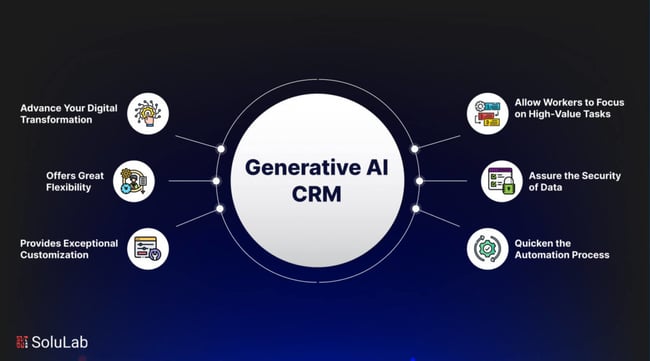
Image source: SoluLab
AI changes this not by adding more data, but by extracting more meaning from what’s already there.
Why buying more lead lists delivers diminishing returns
Lead lists feel like progress because they’re tangible. New names appear, activity spikes, and teams can point to something “net new.” But the underlying problems don’t go away. Data decays quickly, intent is shallow, and the same lists circulate across competitors.
More importantly, lead lists rarely improve decision quality. They increase surface area, not understanding. AI-driven prospecting works in the opposite direction by reducing noise and sharpening focus, which is why teams relying on first-party data tend to see better downstream performance than those constantly expanding the top of the funnel.
Extracting value from first-party CRM data
CRMs are typically treated as systems of record, not systems of learning. Fields get updated, stages move, and then the data just sits there.
AI changes that by analysing patterns across historical outcomes, such as wins, losses, stalled deals, reactivations, and feeding those insights back into prioritisation. Instead of asking “Which accounts match our ICP?”, teams can ask “Which accounts behave like deals that actually moved?”
This is where prospecting starts to feel less speculative and more informed.
Enriching account insight with LinkedIn activity and role changes
LinkedIn signals are often spotted ad hoc: someone notices a job change or a post engagement and reacts. AI allows those signals to be monitored consistently and interpreted in context.
When LinkedIn data is layered onto CRM history, teams can see:
- Role changes that indicate renewed buying influence
- Team expansion patterns that precede budget ownership
- Engagement behaviour that aligns with past buying cycles
Individually, these signals are weak. Together, they often explain why an account is suddenly worth revisiting.
See also: Close More Deals With AI-Driven Lead-to-Opportunity Scoring
Finding Hidden ICP Matches Already in Your Pipeline
One of the most overlooked benefits of AI prospecting is how much opportunity already exists inside most pipelines. Strong-fit accounts don’t disappear; they just fall out of focus when timing isn’t right.
Dormant accounts and missed buying signals
Accounts go quiet for many reasons: internal shifts, competing priorities, incomplete buying groups. Traditional prospecting treats these as dead ends. AI treats them as states that can change.
By continuously monitoring for new signals across previously engaged accounts, AI can flag when conditions start to shift long before someone manually thinks to revisit them. This reframes dormancy from failure into deferred opportunity.
Identifying buying committees, not just contacts
Most B2B deals don’t stall because of poor messaging. They stall because teams are anchored to a single contact in a multi-stakeholder decision.
AI helps surface patterns that indicate broader involvement across an account, such as:
- Multiple roles engaging at different points
- Changes in seniority among active contacts
- Activity spreading across teams rather than individuals
This allows prospecting to move from contact-centric outreach to account-level engagement — a necessary shift in complex sales.
Timing signals humans often miss
Humans are good at spotting obvious intent. They’re far less consistent at recognising subtle timing cues that only matter in combination.
AI continuously tracks changes over time and highlights moments where signals align, often revealing:
- Accounts that appear static but are quietly becoming viable again
- Buying windows opening due to internal changes rather than explicit demand
This doesn’t guarantee conversion. But it significantly improves when teams choose to engage, which is often the difference between progress and polite indifference.
See also: AI-Powered Personalization: Turning Data Into Hyper-Specific B2B Campaigns
Personalization at Scale Without Losing Relevance
Personalization is one of the first things teams promise and the first thing they quietly water down. Not because it doesn’t work, but because it collapses under its own weight once scale enters the picture.
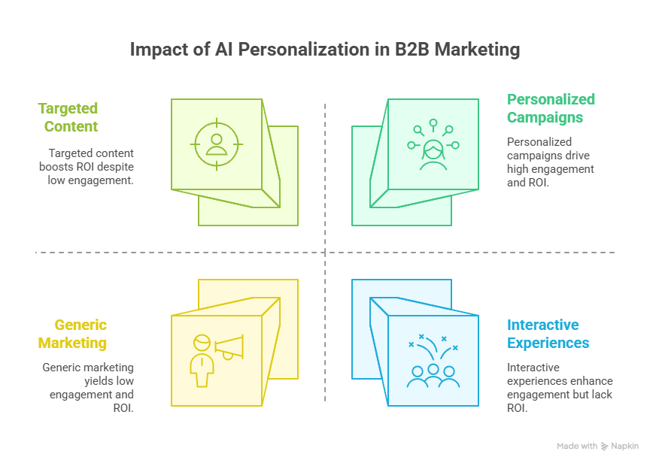
Image source: TTMS
Why manual personalization doesn’t scale
Writing highly tailored messages works right up until it doesn’t. As soon as account volumes increase, teams are forced into trade-offs: relevance or reach, quality or speed. Most choose speed, and “personalization” quietly becomes surface-level tweaks that buyers recognise instantly.
The problem isn’t effort. It’s that manual personalization assumes humans can consistently process context across hundreds of accounts in parallel. They can’t - and expecting them to leads to burnout, inconsistency, and diminishing returns.
AI-generated insights vs. generic templates
AI doesn’t solve personalization by generating better prose. It solves it by generating better inputs.
Instead of starting from a blank page or a rigid template, teams start with account-specific context: signals that explain why this account, why now. That context can include:
- Recent changes inside the account
- Behaviour that aligns with past buying patterns
- Signals indicating rising relevance or urgency
When outreach is anchored in insight rather than phrasing, messages feel relevant even when the structure is shared across accounts.
Making outreach relevant without writing one-off messages
Relevance doesn’t require uniqueness. It requires alignment.
AI enables teams to standardise message frameworks while varying the reasoning behind them. The outreach maintains a consistent tone and structure, but the justification for engagement varies by account context. That’s what allows teams to scale without sounding automated and without asking every rep to reinvent the message each time.
|
Scale relevance without burning out your team Personalisation doesn’t have to mean one-off messages or manual research. See how teams use AI-generated insights to stay relevant at scale without sacrificing consistency or control. Book a free strategy session today.
|
Where AI Prospecting Has the Biggest Impact
AI prospecting delivers value in many places, but its real impact shows up where teams historically struggle to stay disciplined.
Account prioritization and focus
Most teams know they should prioritise. Few do it well, especially under pressure.
AI helps by continuously ranking accounts based on evolving signals rather than static scores. This creates focus not just at the start of the funnel, but throughout it, making it easier to decide which accounts deserve attention now and which can wait.
Improving pipeline quality, not just volume
The strongest impact of AI prospecting isn’t more pipeline. It’s a better pipeline.
Teams tend to see improvements in:
- Conversion rates between early stages
- Deal velocity and time to qualification
- Forecast confidence driven by cleaner inputs
These gains come from removing low-likelihood accounts earlier, not from pushing more names into the funnel.
Better alignment between marketing and sales
Misalignment usually stems from disagreement about what a “good account” actually looks like.
When both teams work from the same AI-driven signals, prioritisation becomes shared rather than debated. Marketing focuses on accounts with demonstrable readiness. Sales engages with accounts that already show meaningful context. That shared understanding reduces friction and keeps effort concentrated where it is most likely to pay off.
Common Mistakes Teams Make With AI Prospecting
AI prospecting fails less because of the technology and more because of how teams frame the problem. The patterns are familiar and avoidable.
Treating AI as a lead-generation shortcut
One of the fastest ways to kill trust in AI prospecting is to position it as a way to “get more leads.” That expectation pushes teams toward volume-first use cases and sets them up for disappointment.
AI is not a faster list builder. Its value shows up when it helps teams exclude accounts that don’t deserve attention and concentrate effort where it’s most likely to convert. When success is defined as more names rather than better decisions, AI simply accelerates the wrong behaviour.
Feeding AI poor or incomplete data
AI doesn’t magically fix bad inputs. It amplifies whatever it’s given.
Common issues include:
- Inconsistent CRM hygiene and incomplete deal history
- Overreliance on third-party data with little context
- Missing feedback loops between outcomes and targeting
When models aren’t grounded in reliable first-party signals, prioritisation becomes noisy, and confidence in the output drops quickly.
Measuring activity instead of outcomes
Many teams evaluate AI prospecting using the same metrics they use for manual outreach: emails sent, accounts touched, and meetings booked. Those numbers move easily and say very little.
AI prospecting should be judged on downstream impact: conversion quality, deal velocity, and how early poor-fit accounts are filtered out. If activity is up but outcomes don’t change, the problem isn’t adoption but misalignment.
See also: How to Identify Sales Pipeline Leakage Points with AI Attribution
What Marketing Leaders Should Focus on First
AI prospecting works best when leaders resist the urge to start with tools and instead focus on fundamentals.
Data readiness before tooling
Before introducing AI, teams need a clear view of the data they already have and how it’s used. That doesn’t mean perfect cleanliness, but it does mean understanding which signals are trustworthy and which aren’t.
More importantly, it means deciding what outcomes the system should learn from. Without that clarity, even the best models struggle to deliver consistent value.
Clear ownership across marketing, sales, and RevOps
AI prospecting cuts across functions, which is why it often stalls.
Ownership needs to be explicit:
- Who defines what “good fit” means
- Who validates prioritisation logic
- Who feeds outcomes back into the system
When accountability is shared loosely, alignment erodes quickly. When ownership is clear, prioritisation becomes a shared language instead of a recurring argument.
Metrics that reflect revenue impact
Leaders should expect AI prospecting to improve decision quality — not just surface activity.
That shows up in metrics like:
- Conversion rates between early stages
- Time to meaningful sales engagement
- Pipeline value per account prioritized
These indicators move more slowly than activity metrics, but they’re far more honest.
From Guesswork to Precision in B2B Prospecting
AI changes prospecting by shifting it from intuition-led to evidence-led. Instead of spreading effort evenly across accounts that look similar on paper, teams can concentrate on the ones showing real signs of readiness, even when those signs aren’t obvious.
In practice, better prospecting looks quieter. Fewer accounts are pursued at once. Clearer prioritisation. Less time spent disqualifying and more time progressing conversations that matter.
The risk of sticking with outdated methods isn’t falling behind on technology. It’s continuing to invest time and budget into prospecting motions that create the illusion of momentum without improving outcomes. As competitors get sharper about where they focus, guesswork becomes increasingly expensive.
|
Ready to rethink how your team approaches prospecting? If your pipeline looks busy but underperforms, the issue may be prioritisation and not effort. See how AI-driven prospecting helps teams focus on the accounts that actually move. Book a free strategy session with our team.
|
FAQs
How is AI prospecting different from marketing automation?
Marketing automation executes predefined workflows. AI prospecting influences decisions. Instead of just triggering actions, AI analyses patterns across outcomes to help teams prioritise which accounts deserve attention in the first place.
Does AI prospecting replace human judgment?
No, it changes where judgment is applied. AI narrows the field by filtering noise and surfacing higher-likelihood accounts. Humans still make the final calls on relevance, messaging, and commercial strategy.
What data is required to get value from AI prospecting?
AI prospecting works best with first-party data such as CRM history, engagement patterns, and deal outcomes. The data doesn’t need to be perfect, but it does need enough consistency to identify patterns over time.
How long does it take to see results from AI prospecting?
Early improvements often show up in prioritisation and focus within weeks. More meaningful impact - cleaner pipeline, better conversion rates - typically follows once models have learned from real outcomes.
Is AI prospecting more relevant for marketing or sales teams?
It sits between both. Marketing benefits from better account selection and relevance, while sales benefits from higher-quality conversations. The biggest gains happen when both teams work from the same prioritisation signals.