




Generative Engine Optimization (GEO) spans every major marketing function. Here's how to build the structure to manage it.
Most marketing teams that have started thinking about Generative Engine Optimization have made the same mistake: they've handed it to the SEO team. That instinct is understandable — GEO involves content, search intent, and technical optimization. But the comparison stops there.
Traditional SEO operates within a single function. GEO doesn't. AI models synthesize brand signals from PR coverage, authority from third-party citations, entity clarity from technical infrastructure, topical depth from content investment, and category positioning from the consistency of how you describe yourself across every owned and earned channel. None of those inputs live in one team.
The result, in most organizations: GEO sits on a shared roadmap with no single accountable owner, limited cross-functional coordination, and a budget that hasn't shifted to reflect what actually drives AI visibility. This article gives you a concrete organizational model to fix that — covering ownership structure, quarterly process, and budget reallocation.
Why GEO Breaks Standard Marketing Org Structures
The inputs are cross-functional by design
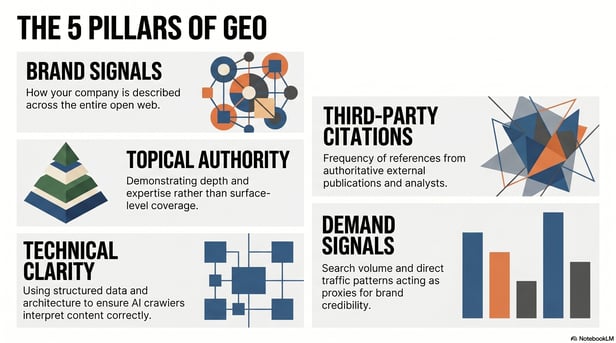
To understand why standard org structures fail GEO, start with what actually determines AI inclusion. When a generative engine decides whether to cite your brand in response to a query, it's drawing on five distinct signal types:
-
Brand signals — how your company, product, and category are described across the open web, including sites you don't control
-
Topical authority — whether your content demonstrates depth and expertise on the subject, not just surface coverage
-
Third-party citations — how frequently authoritative external sources (publications, analysts, review platforms) reference your brand in relevant contexts
-
Technical clarity — whether structured data, entity canonicalization, and site architecture allow AI crawlers to correctly interpret your content
-
Demand signals — brand search volume and direct traffic patterns that function as proxies for credibility
Brand signals are a comms and brand function problem. Topical authority is a content strategy problem. Third-party citations are a PR and partnerships problem. Technical clarity is an SEO and engineering problem. Demand signals are a demand gen and paid media problem. There is no single team that owns all five, and progress on two or three without the others produces limited results.
Where ownership gaps typically appear
The most common failure mode is the SEO team picking up GEO work in isolation. They optimize content, implement structured data, and start monitoring AI outputs — but they can't compel PR to pursue citation-building coverage, redirect the content budget toward authority assets, or enforce consistency in how brand and product are described across channels.
The second failure mode is diffuse ownership: GEO appears as a line item in three or four team roadmaps, no one has budget authority across functions, and it loses prioritization battles every quarter because no single leader is accountable for the outcome.
Both failures are organizational, not executional. The teams typically have the skills to do the work. The problem is structural and thus, requires a structural fix.
See also: SEO vs GEO for B2B: How AI Is Changing Search Strategy
|
How often does your brand show up in AI answers compared to your competitors? We'll run your top commercial queries across ChatGPT, Perplexity, Gemini, and Claude — and show you exactly where you're present, where you're absent, and what's driving the gap.
|

The Organizational Model That Works
Effective GEO programs use a two-layer ownership structure: an executive sponsor with cross-functional authority, and an internal GEO lead with day-to-day operational accountability. The two roles are distinct and both are necessary.
Layer one: the executive owner
In most organizations, the right executive owner is the CMO or VP Marketing. The role requires three specific capabilities that only this level of leadership can provide:
-
Budget authority across functions — GEO requires redirecting spend from established channels, which creates internal resistance. Only an executive owner can approve those shifts without getting blocked in planning cycles.
-
Cross-team prioritization power — when PR's quarterly plan conflicts with GEO's citation-building requirements, or when content velocity targets compete with authority-asset investment, the executive owner resolves that conflict. A GEO lead who reports into content or SEO cannot.
-
Revenue-level accountability — GEO KPIs need to sit alongside pipeline metrics in QBRs, not in a separate marketing performance review. The executive owner is the person who brings AI visibility data into that conversation and connects it to opportunity creation.
What the executive owner is not responsible for: brief-level decisions, platform monitoring, content production, or day-to-day coordination. Those belong to the GEO lead.
Layer two: the GEO lead
The GEO lead is the internal DRI for everything operational. In most mid-market organizations, this is a reoriented remit for an existing senior hire — typically someone who sits in SEO, content strategy, or growth — rather than a new headcount.
The role has four core accountabilities:
-
Topic selection and cluster prioritization — determining which subjects the organization should build AI visibility around each quarter, based on pipeline data, competitive monitoring, and current inclusion rates
-
Brief ownership — writing and QA-ing content briefs that include GEO-specific requirements (structured formats, citation targets, distribution requirements), not just SEO specs
-
AI surface monitoring — systematic tracking of brand mention rates, citation sources, and answer framing across priority platforms
-
Cross-functional coordination — running the quarterly GEO process across content, SEO, PR, and demand gen, and escalating blockers to the executive owner
At minimum, this is a 50% role in a mid-market organization. In enterprise, it's full-time. The most common mistake is treating it as a 10–15% add-on to an existing SEO or content manager role — the workload and cross-functional coordination requirements make that unworkable at any meaningful program scale.
Functional responsibilities by team
Below the GEO lead, each function has defined GEO responsibilities that run alongside their core work. These are not separate workstreams — they're integrated into existing processes with specific GEO requirements added.
Content team: Executes GEO-optimized briefs. Responsible for topical authority development — building comprehensive, structured assets (definitions, comparison frameworks, FAQ formats) that match how AI models synthesize answers. Also owns the content update cycle based on AI monitoring outputs.
SEO/technical team: Owns structured data implementation, entity canonicalization, and site architecture decisions that affect AI crawlability. Responsible for schema audit and maintenance, and for ensuring knowledge panel accuracy across platforms.
PR and comms: Responsible for third-party citation strategy — identifying which authoritative publications, analyst firms, and review platforms AI models cite when covering your topic clusters, and pursuing coverage in those sources. Also monitors competitor citation patterns.
Brand: Enforces consistent entity definition across channels. AI models learn from repetition — how you describe your category, product, and positioning needs to be consistent across owned content, paid media, and partner channels. Brand owns that consistency.
Demand gen: Brand search volume is a GEO signal — AI models weight brands that demonstrate credible demand. Demand gen protects branded keyword share, contributes to brand search volume through campaign activity, and owns CRM tagging for AI-influenced pipeline attribution.
See also: Designing a GEO-Ready Content Portfolio for the B2B Buyer Journey
The Quarterly GEO Process
GEO without a repeatable operational cadence becomes ad hoc experimentation. The following quarterly rhythm makes it systematic — covering topic selection, brief production, monitoring, and iteration in a sequence that compounds over time.
Month one: topic selection
Topic selection determines where the organization concentrates its GEO investment for the quarter. It's a strategic decision, not a keyword research exercise, and it requires inputs from four sources:
-
AI monitoring data: which topics are competitors currently being cited for? Where are you absent from answers that you should appear in?
-
Sales intelligence: what questions are buyers asking that reps can't answer with existing content? Where is the missing content creating friction in active deals?
-
Pipeline data: which solution categories are driving the most qualified inbound? Topics that align with a high-velocity pipeline get prioritized.
-
Current inclusion baseline: for topics you already produce content on, what's your actual citation rate in AI outputs? Topics where you have content but no AI inclusion are often faster wins than net-new territory.
The output is a prioritized topic cluster list — typically 8–12 clusters per quarter for a mid-market organization — with owner assignment and a rationale for each. This is not a keyword spreadsheet. It's a semantic map that shows which subjects you're building authority around, which teams are accountable for each, and what success looks like by end of quarter.
Selection criteria that matter most: commercial intent (does AI visibility on this topic influence buyer decisions?), current inclusion gap vs. competitors, cross-functional feasibility (is PR positioned to support citation-building on this cluster? Is the technical infrastructure in place?).
Content briefs with GEO requirements
Standard SEO briefs optimize for search intent, keyword targets, and on-page structure. GEO briefs require five additional specifications:
-
Target platforms and query formats — which AI platforms and what types of queries should this content appear in? A brief targeting ChatGPT research queries looks different from one targeting Perplexity's cited-source format.
-
Required citation anchors — which external sources should the content cite, reference, or align with to build credibility with AI models?
-
Structured content elements — which FAQ formats, definition blocks, and comparison frameworks need to be included to match how AI engines synthesize answers?
-
Third-party distribution requirements — what PR placements or external coverage does this topic cluster need to support AI citation? The brief should specify this before production begins, not after.
-
Entity consistency requirements — how should the brand, product, and category be described in this asset? This must align with the canonical definitions Brand has defined.
Brief review process: GEO lead QAs for GEO requirements, content lead confirms production feasibility, SEO lead validates technical specs, PR lead confirms distribution plans. All four before a brief enters production. This sounds like overhead — in practice, a brief review meeting runs 20–30 minutes and eliminates the far more expensive problem of producing content that doesn't perform.
AI surface monitoring
Monitoring is where most early GEO programs are weakest. The question isn't just "Is our brand mentioned?" — it's four distinct questions that require different responses:
-
Brand mention rate: across priority topic queries on ChatGPT, Perplexity, Gemini, and Claude, what percentage of responses include our brand? Track this by platform and topic cluster.
-
Citation source analysis: which external sources are AI models citing when they reference our topic clusters? Are competitors benefiting from sources we should also be on?
-
Answer framing: how is our category being defined in AI responses? Does that framing align with our positioning? Misalignment here is a brand and content problem to fix upstream.
-
Competitor inclusion tracking: which competitors appear in AI responses for our priority queries? What's driving their inclusion that we're not doing?
Tooling options at time of writing: Profound, Scrunch AI, and Brandwatch's AI visibility features cover structured brand monitoring across major platforms. For organizations not yet ready to invest in dedicated tooling, a structured manual testing protocol — standardized queries run weekly by the GEO lead across 3–4 platforms — provides a workable baseline.
Monitoring cadence: weekly lightweight checks by the GEO lead; monthly structured reporting with trend data delivered to the executive owner; quarterly competitive benchmark reviewed in the team planning session.
Rapid iteration protocol
Unlike traditional SEO — where content improvements take 3–6 months to register in rankings — GEO responds faster to authority signal changes. AI models re-index more frequently and are more sensitive to shifts in citation patterns and content quality. This means a faster iteration cycle is both possible and necessary.
Decision framework for rapid response:
-
Update existing content when: monitoring shows low citation rate on a topic where you already have assets, and the gap is quality or structure rather than authority. Timeline: 2–3 weeks.
-
Create net-new content when: monitoring identifies a topic cluster where competitors are being cited and you have no relevant asset. Timeline: 4–6 weeks including PR distribution lead time.
-
Pursue external citation when: you have strong content but low citation rate, suggesting the gap is third-party authority rather than content quality. PR lead takes point; timeline: 6–10 weeks for meaningful placement.
Rapid iteration authority: the GEO lead can trigger content updates and external citation campaigns without waiting for the next quarterly cycle. Net-new content creation above a defined cost threshold requires executive owner approval. Establish these thresholds at the start of the program — ambiguity about who can authorize what will slow response times when competitive urgency demands speed.
|
Which GEO signals are you missing right now? We map your performance across the five inputs that drive AI visibility — brand signals, authority, citations, technical structure, and demand — and pinpoint what’s holding you back.
|
Where the Budget Shifts — and Why
GEO doesn't require a larger marketing budget in most organizations. It requires a different allocation. The shifts are predictable, the rationale is clear, and the internal resistance is real — particularly from teams whose volume-based metrics take a short-term hit during reallocation.
From long-tail content volume to authority-building assets
The traditional content marketing model rewards velocity: more posts, more keyword targets, more indexed pages. That model works in a world where search rankings are proportional to content volume. It doesn't work in a world where AI models weight perceived authority and depth over quantity.
An AI engine deciding whether to cite your brand on a topic doesn't count your blog posts. It evaluates whether your content represents the most authoritative, comprehensive, and credible source available. Ten shallow posts on adjacent topics consistently lose to one well-researched, expert-authored, structurally sound definitive resource.
The budget implication: reduce content production frequency and reinvest in fewer, higher-quality assets. This is the conversation that most often requires executive owner authority to resolve. Content teams are measured on output volume. Reducing that volume, even with a quality-for-quantity justification, requires leadership cover.
Structured data and technical infrastructure
Structured data — schema markup for products, FAQs, articles, organizations, and how-to content — is one of the clearest signals AI crawlers use to understand entity relationships and content relevance. Most marketing organizations have treated it as a low-priority technical task. In GEO, it's a budget line.
What typically needs dedicated investment:
-
Schema audit and implementation: a full audit of existing structured data coverage, identification of gaps, and systematic implementation across priority content. For most mid-market sites, this is a 40–80 hour engineering engagement, typically outsourced or handled by a technical SEO specialist.
-
Entity canonicalization: ensuring your brand, products, and key personnel are described consistently across all owned properties so AI models can correctly resolve your entity. This involves content, brand, and technical coordination — it's not purely an engineering task.
-
Knowledge panel and entity coverage: claiming and optimizing brand presence in knowledge graphs (Google, Wikidata, Crunchbase) that AI models draw from when constructing responses about your company.
GEO-focused research and original data
Original research is the highest-ROI content investment for GEO. AI models cite original sources — proprietary surveys, first-party benchmark data, and exclusive analysis — at significantly higher rates than secondary content that synthesizes publicly available information. When you produce original data, you become a citable source rather than a synthesizer of other people's sources.
A realistic research investment cadence: one original research project per half-year. This could be a survey of 200–500 respondents in your target segment ($8,000–15,000 through a panel provider), analysis of proprietary platform data you already collect, or a benchmark report drawing on anonymized customer data. The output gets distributed through PR as news, used as the foundation for a GEO-optimized pillar asset, and becomes a citation target for the next 12–18 months.
Making the case to finance
The honest challenge in GEO budget conversations is that the measurement infrastructure is still maturing. You cannot point to established ROI benchmarks for GEO spend the way you can for paid search or content marketing at scale. Finance will push back on this.
The defensible framing is competitive positioning with leading indicators, not performance marketing with direct attribution. The argument: AI assistants are becoming a primary discovery channel for B2B buyers. Your competitors are investing in GEO. The cost of being absent from AI answers is lost consideration before a buyer enters your funnel — and that cost is invisible in your current reporting. The investment is about not falling behind in a channel that's growing, not about generating a measurable return in quarter one.
Leading indicators you can track and report from the start: brand mention rate in AI outputs for priority queries, citation source coverage vs. competitors, brand search volume trends (a proxy for AI-driven awareness), and — as pipeline data accumulates — self-reported source attribution from new opportunities. These aren't perfect metrics, but they're trackable from day one and they create a data record that makes the ROI case stronger over time.
What not to promise: specific traffic or lead volume outcomes from GEO spend in year one. The models are changing, measurements are imperfect, and overpromising in this space creates credibility problems when results take longer than expected to materialize.
See also: The CMO’s Guide to Generative Engine Optimization (GEO) in B2B
The Organizational Question Is the Real Bottleneck
Most marketing organizations have the talent to execute GEO. The limiting factors are structural: no single owner with cross-functional authority, no repeatable process that spans content, PR, SEO, and brand, and no budget reallocation away from volume-based metrics toward authority-building investment.
The two-layer ownership model — executive sponsor plus operational GEO lead — solves the authority problem. The quarterly process solves the coordination problem. The budget shift solves the investment problem. None of these are technically complex. All of them require deliberate organizational decisions that only leadership can make.
Key Takeaways
-
GEO is a cross-functional discipline — brand, content, SEO, PR, and demand gen all contribute signals that determine AI visibility. Assigning it to one team produces partial results at best.
-
Effective GEO programs need two layers of ownership: an executive sponsor (CMO or VP Marketing) with budget authority across functions, and an internal GEO lead with operational accountability for topic selection, briefs, monitoring, and cross-team coordination.
-
The quarterly process is what separates systematic GEO from ad hoc experimentation — topic selection driven by pipeline and AI monitoring data, briefs with explicit GEO requirements, structured platform monitoring, and a defined rapid iteration protocol.
-
Budget reallocation matters more than budget increases: shift from content volume toward authority-building assets, invest in structured data and entity canonicalization, and treat original research as a citation-building asset rather than a content marketing nice-to-have.
|
Where is your brand invisible in AI-driven buying journeys? We identify the high-intent queries where you should appear — but don’t — and what’s driving that gap.
|