



AI is becoming the first place B2B buyers go to understand markets, evaluate options, and form shortlists. This guide explains what that shift means for visibility, authority, and revenue. and how CMOs should respond.
B2B discovery is quietly changing. Not replacing search, but front-running it.
Before buyers visit websites, compare vendors, or download reports, they are increasingly asking AI systems to explain the landscape for them. What are the leading approaches? Which vendors matter? What trade-offs should they be aware of? By the time traditional marketing touchpoints come into play, key decisions about relevance and fit are often already taking shape.
The scale of this shift is easy to underestimate. AI-generated summaries now appear in roughly half of search experiences, with that share expected to climb sharply over the next few years. At the same time, a growing majority of buyers report intentionally using AI-powered search and assistant tools as their primary source for making purchasing decisions.
For marketing leaders, this changes the risk profile. The problem is not losing clicks or rankings. The real risk is losing consideration — being absent from the explanations, comparisons, and synthesized answers that shape early shortlists. A brand can still perform well in classic SEO metrics and yet be effectively invisible in the environments where buyers are forming their first impressions.
A Practical Example: When Strong SEO Isn’t Enough
Consider a fictional B2B SaaS company, SignalStack, a mid-market analytics platform.
SignalStack ranks on page one for several high-intent keywords. It generates steady organic traffic. It has comparison pages, blog content, and technical documentation. By traditional SEO standards, performance looks solid.
But when a procurement lead asks an AI assistant:
“What are the leading analytics platforms for mid-sized SaaS companies?”
SignalStack is not mentioned.
The AI highlights three competitors instead — companies with clearer category ownership, stronger executive commentary, and more consistent positioning across sources.
SignalStack didn’t lose traffic. It lost inclusion.
That gap is the difference between SEO performance and GEO maturity.
What Generative Engine Optimization Actually Is
GEO is the discipline of ensuring your company is consistently included, positioned correctly, and trusted in AI-generated answers that shape B2B buying decisions.
That definition is deliberately narrow. GEO does not try to control every output of every model. Instead, it focuses on the probability and quality of inclusion when generative systems explain a category, compare approaches, or outline vendor options — the moments that influence who is considered and who is filtered out.
What GEO Is Optimizing For
First, inclusion in synthesized answers.
Generative systems do not retrieve and rank pages; they assemble responses from patterns of knowledge and perceived authority. GEO increases the likelihood that your brand appears at all when AI systems construct those responses.
Second, the framing of your category and your role within it.
Being mentioned is not enough. GEO is concerned with how your company is described: whether you are framed as a category leader, a specialist, a credible alternative, or a marginal option. That framing directly influences buyer perception before any direct interaction occurs.
Third, consistency across multiple AI surfaces.
B2B buyers do not rely on a single system. They move between search, copilots, assistants, and embedded AI experiences. GEO aims to create a stable, repeatable representation of your brand across these environments so that familiarity compounds rather than fragments.
What GEO Is Not
GEO is not prompt hacking.
Trying to reverse-engineer individual prompts or force mentions through tactical tricks does not scale and does not build durable influence.
It is not ranking manipulation.
There is no “position one” in a synthesized answer. The competitive dynamic is inclusion and emphasis, not order.
And it is not a replacement for SEO, content, or brand strategy.
GEO builds on all three. Without solid SEO foundations, credible content, and clear positioning, there is nothing for generative systems to recognise or reuse.
The difference can be summarised simply:
SEO optimises for retrieval.
GEO optimises for interpretation.
See also: How to Make Your Content Discoverable in the AI Search Era: Writer’s Checklist
Why GEO Is Fundamentally Different From SEO
Traditional SEO is built on a set of assumptions that no longer hold consistently in AI-mediated discovery.
What SEO Assumes
SEO assumes that:
-
Users ask questions, engines retrieve documents, and users decide.
-
Pages are discrete, attributable assets with measurable performance.
-
Visibility is primarily a function of clicks, impressions, and rankings.
In that model, success is observable. Marketing teams can see what content performs, what traffic converts, and where attribution begins and ends.
What Generative Engines Assume
Generative systems operate on very different premises:
-
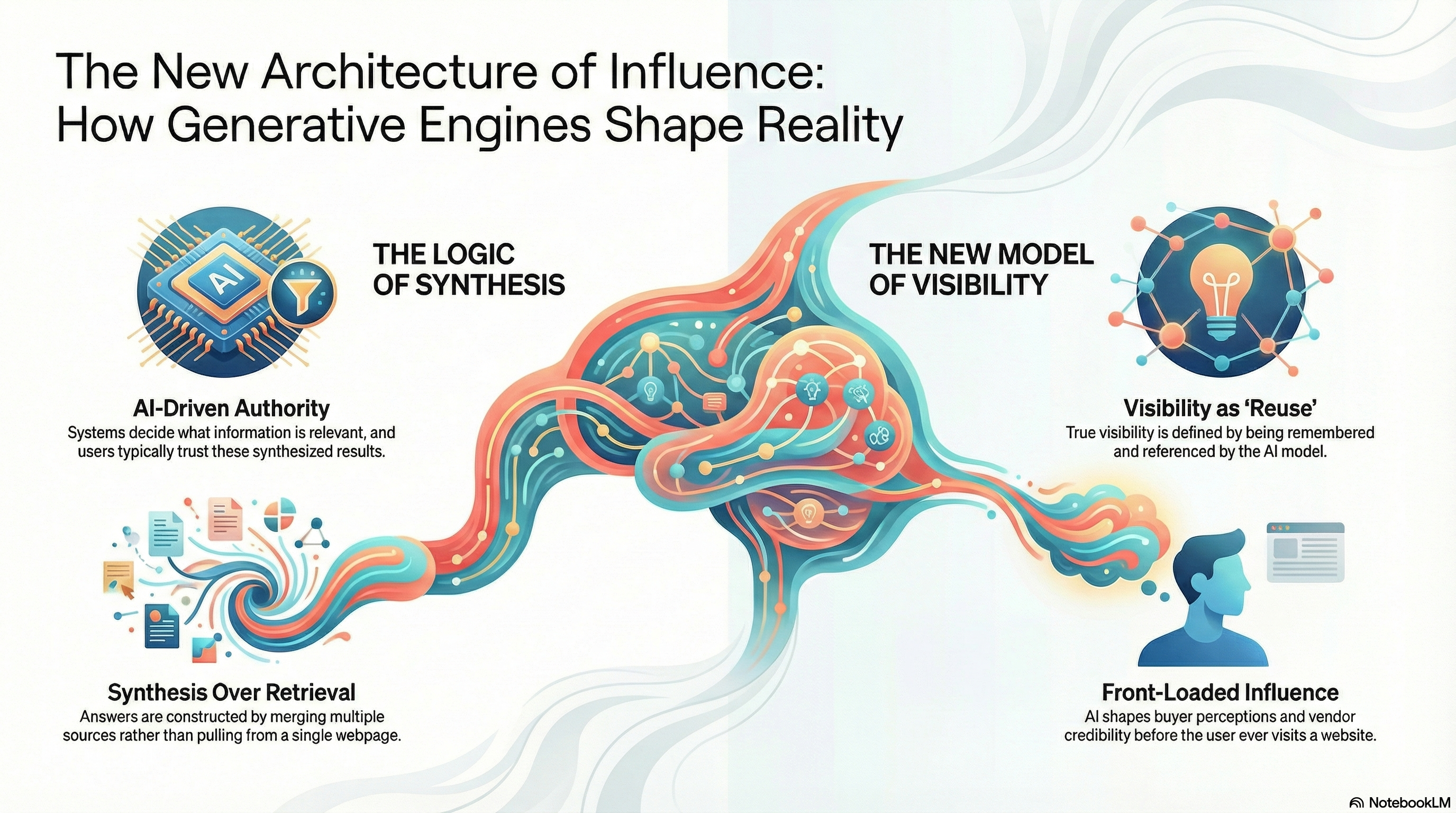
Users ask questions, systems decide what matters, and users often trust the output.
-
Answers are synthesized from many sources, not retrieved from one.
-
Visibility is not a click — it is being remembered, referenced, and reused.
In this environment, influence is front-loaded. By the time a buyer clicks through to a website, the AI system may already have shaped how they think about the category and which vendors are credible.
Why This Changes the Competitive Landscape
SEO competition is explicit. You know who ranks above you and why. GEO competition is implicit. You are competing to be part of the system’s internal representation of your market — its “mental map” of who does what, who leads, and who belongs.
That mental map is shaped by:
-
Consistency of narrative
-
Depth of demonstrated expertise
-
Clarity of positioning across sources
This is why some brands with strong SEO performance still fail to appear in AI-generated explanations, while others with less traffic but clearer positioning are repeatedly surfaced.
The Implication for CMOs
You are no longer competing only for page one. You are competing to become structurally legible to systems that increasingly mediate how buyers understand your market. That requires moving beyond optimisation for visibility and toward optimisation for meaning.
|
Pressure-test your positioning for an AI-first buying journey If AI systems explained your category today, would your brand show up — and would it be framed correctly? Book a free strategy session today.
|

GEO vs. AI Overviews Optimization
Much of the current GEO conversation gets stuck at the SERP level. That’s understandable — AI Overviews are visible, measurable, and disruptive to existing SEO playbooks. But treating GEO as a response to Google alone is a category error.
AI Overviews optimization is inherently:
-
SERP-specific, tied to one interface
-
Platform-controlled, governed by Google’s retrieval and summarization rules
-
Extractive, often pulling fragments of content without preserving context or positioning
Optimizing for AI Overviews is largely about eligibility and extraction: structuring content so it can be summarized, cited, or paraphrased within Google’s ecosystem.
GEO operates at a different layer entirely, and is:
-
Cross-platform, spanning search engines, copilots, assistants, and embedded AI tools
-
Vendor-agnostic, shaped by how models reason across sources rather than how one platform ranks pages
-
Decision-oriented, influencing which vendors are considered credible enough to include in comparisons and shortlists
The strategic distinction matters. AI Overviews are a distribution layer — they affect how content is surfaced within a specific channel. GEO is a market-perception layer — it influences how your category and brand are understood before channel-specific interactions begin.
For CMOs, this means optimizing for AI Overviews may protect visibility in Google, but it does little to address how buyers encounter and evaluate your brand when discovery happens elsewhere. GEO exists to solve that broader problem.
See also: The Rise of AI-Driven Content Creation: What Works and What Doesn’t for B2B
Why GEO Matters Now in B2B
GEO is emerging now not because of technological novelty, but because it aligns with how B2B buying behaviour is already evolving.
1. AI Is Compressing the Research Phase
B2B research is becoming narrower and faster. Buyers are opening fewer tabs, consulting fewer sources, and engaging in fewer vendor comparisons. Instead of manually assembling an understanding of the market, they increasingly ask AI systems to do that synthesis for them.
The consequence is simple but significant: fewer vendors make it into the initial frame of reference. Once that frame is set, everything that follows — comparisons, demos, procurement — operates within it.
2. Early-Stage Discovery Is Becoming Invisible
Buyers still research, but much of that research now leaves no trace in traditional analytics. There are no impressions to track, no sessions to attribute, no keywords to monitor.
Brand impressions happen inside AI interfaces, copilots, and assistants — environments where marketing teams have limited visibility but meaningful influence. GEO does not restore traditional attribution, but it addresses the strategic risk of being absent where early understanding is formed.
3. AI Answers Are Starting to Resemble Analyst Summaries
Generative answers are not neutral encyclopedias. They increasingly behave like analyst briefings: comparative, opinionated, and confidence-weighted. They highlight trade-offs, suggest leaders, and implicitly rank approaches.
This matters because buyers tend to trust confident synthesis, especially in complex B2B categories. When AI answers act as de facto analysts, absence is no longer a timing issue.
|
See how your brand is being represented before buyers ever visit your site Traditional analytics can’t show you early AI-shaped discovery. GEO focuses on what happens before the funnel starts. Book a free strategy session today.
|
How Generative Engines Decide Which B2B Brands Matter
While generative systems differ in architecture and data sources, the signals they rely on to assemble answers are surprisingly consistent. These signals cluster into three broad categories.
Signal Cluster 1: Narrative Clarity
Generative engines reward brands that are easy to place within a category.
Clear category ownership, stable positioning language, and explicit differentiation make it easier for systems to include you with confidence. Ambiguity, shifting narratives, or overly broad claims increase the likelihood of exclusion.
In SignalStack’s case, its website described the product as “data intelligence infrastructure,” its blog framed it as “advanced reporting software,” and analysts categorized it as “BI tooling.” The lack of stable category ownership made it harder for generative systems to confidently include it in shortlist-style answers.
Signal Cluster 2: Expertise Density
Generative systems favour content that demonstrates decision-level expertise. High-level explainers are abundant; nuanced analysis is not.
Brands that articulate trade-offs, limitations, and strategic implications signal authority. Strong points of view — even when they narrow appeal — are more likely to be surfaced than neutral, consensus-driven content.
Signal Cluster 3: Cross-Source Coherence
Generative engines synthesize across sources. They compare what your website says with what your long-form content explains, what your executives articulate, and how third parties describe you.
When those signals align, recall strengthens. When they contradict, confidence drops.
This is where many B2B brands struggle. Messaging that diverges by channel may still perform in SEO, but it weakens GEO because it fragments meaning.
The governing principle is simple:
GEO rewards coherence, not volume.
Publishing more content does not help if that content pulls the narrative in multiple directions. Clear, consistent articulation across fewer, stronger assets is more effective than broad coverage without alignment.
In SignalStack’s case, the issue wasn’t a lack of content — it was fragmentation. The homepage positioned the company as a “data intelligence platform.” Blog content referred to it as “advanced SaaS analytics.” Founder interviews described it as “infrastructure for revenue insights.” Analysts categorized it differently again.
When an AI system attempted to synthesize the analytics vendor landscape, SignalStack’s role was inconsistent across sources. Meanwhile, competitors surfaced repeatedly because their positioning — across website copy, executive commentary, and third-party coverage — reinforced the same market role. Coherence increased their probability of inclusion. SignalStack’s inconsistency reduced it.
See also: ChatGPT, Perplexity & AI Mode Search: What B2B Marketers Must Do to Boost Visibility
The GEO Maturity Model for B2B Teams
Most B2B organizations are already participating in GEO — they just aren’t doing it intentionally. The difference between leaders and laggards is not awareness, but maturity. The following model reflects how GEO typically shows up in practice.
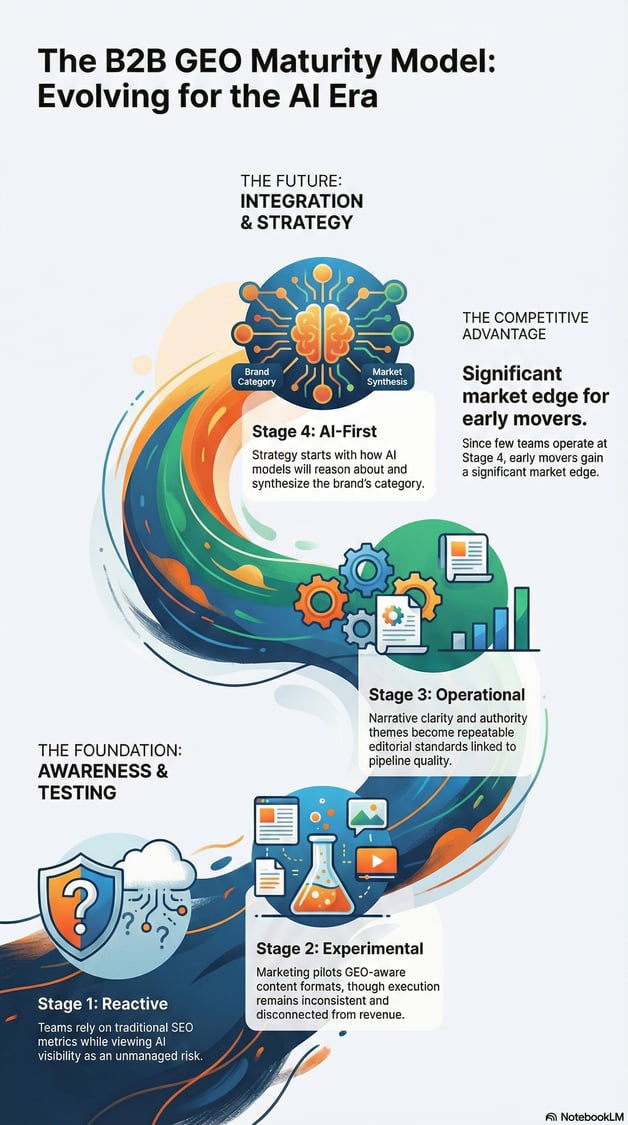
Stage 1: Reactive
At the reactive stage, GEO enters the conversation as a concern rather than a strategy.
Teams notice competitors appearing in AI-generated answers, summaries, or comparisons. There is a growing sense that something important is happening upstream of the funnel, but no clear ownership or response. Framing is effectively outsourced to the model.
Decision-making still revolves around familiar SEO metrics: rankings, traffic, and impressions. When AI visibility is discussed, it is treated as an anomaly rather than a signal. The organization senses risk, but lacks a way to act on it.
SignalStack would fall squarely into this stage. The marketing team saw steady organic traffic and assumed market visibility was strong. It was only when sales noticed prospects referencing competitors surfaced by AI assistants that the gap became visible. There was no monitoring of AI-generated vendor lists, no analysis of framing, and no ownership of the issue. SEO performance masked the fact that SignalStack was being excluded from early-stage AI summaries.
Stage 2: Experimental
In the experimental stage, teams begin testing GEO consciously, but unevenly.
Marketing pilots GEO-aware content formats — clearer definitions, category explainers, or POV-driven pieces. Early audits of AI mentions appear, often driven by curiosity rather than discipline. Results are reviewed, but rarely connected to pipeline or revenue outcomes.
Execution is inconsistent. Some teams adapt quickly; others continue producing content as before. GEO exists, but it is not yet integrated into how decisions are made.
Stage 3: Operational
At the operational stage, GEO becomes a repeatable capability.
Principles of narrative clarity, authority, and coherence are embedded into editorial standards. Authority themes are explicitly defined and reinforced across channels. AI visibility is reviewed alongside pipeline quality and inbound fit, not in isolation.
GEO is no longer an experiment. It informs how content is planned, how positioning is articulated, and how success is evaluated.
For SignalStack, reaching this stage would mean explicitly defining its category position — for example, committing to “mid-market SaaS analytics platform” and reinforcing that language across every surface. It would require aligning website messaging, executive interviews, product pages, and thought leadership around the same narrative. It would also mean regularly auditing AI-generated vendor summaries to assess inclusion and framing, not just tracking rankings and traffic.
Stage 4: AI-First
In the AI-first stage, GEO shapes strategy rather than reacting to it.
Content planning starts with a simple question: How will AI systems explain this category and our role within it? Positioning is designed for synthesis, not extraction. Messaging anticipates how models will reason about trade-offs, differentiation, and credibility.
GEO informs go-to-market strategy, messaging frameworks, and sales enablement. The organization does not chase AI visibility — it earns it through clarity and consistency.
Few teams operate fully at this level today. That gap represents an advantage for those who move early.
How CMOs Should Operationalize GEO (Without Creating Chaos)
The biggest risk in adopting GEO is overreaction. GEO does not require a new team, a new stack, or a fundamental reorganization. It requires discipline in ownership and execution.
Where GEO Should Live
Marketing should own GEO. Narrative clarity, authority, and coherence are core marketing responsibilities. GEO formalizes those responsibilities in an AI-mediated environment.
RevOps plays a validation role. While GEO influence is difficult to attribute directly, RevOps can correlate improvements in inbound quality, deal velocity, and pipeline fit with changes in how the brand is framed upstream.
Sales reinforces the positioning shaped by GEO. When sales conversations align with the framing buyers encountered through AI, trust accelerates rather than resets.
What Changes in Practice
GEO changes what content teams prioritise, not how fast they publish.
Generic explainers become less valuable. Decision-stage frameworks, explicit comparisons, and clear trade-offs become more important. Content is written to help systems — and humans — understand not just what you do, but why you matter.
For SignalStack, this would require shifting away from generic “what is analytics?” blog posts and toward decision-level content such as “How mid-sized SaaS teams should evaluate analytics platforms” or explicit competitor comparisons. The goal would not be more content, but clearer signals — assets that make its category ownership and differentiation unambiguous to both buyers and generative systems.
What Doesn’t Change
SEO still matters. Without strong foundations, GEO has nothing to build on. Brand still compounds slowly; there are no shortcuts to authority. And quality continues to beat speed, especially in environments where coherence is rewarded.
See also: Optimize for Trust, Not Traffic: Learn Modern SEO Tactics for 2025
What GEO Means for the CMO Role
For most of the last decade, the CMO mandate has been framed around demand capture: generate pipeline, support sales, and prove ROI once intent becomes visible. GEO breaks that model. When AI systems become the first place buyers go to understand a market, marketing no longer enters at the point of demand — it enters at the point of definition.
Before a buyer evaluates vendors, AI answers are already shaping what the problem is, which approaches are credible, and who belongs in the conversation at all. That shifts the CMO’s responsibility upstream. Marketing is no longer just driving interest in a solution; it is influencing which solutions are even considered legitimate.
Key Takeaways
-
Your real competition now happens before the funnel. If AI systems don’t include your brand when explaining the category, you’re not losing traffic — you’re being excluded from consideration before intent exists.
-
Positioning has become an execution problem, not a messaging exercise. GEO exposes whether your positioning is clear, stable, and strong enough to be reused by systems that don’t tolerate ambiguity.
-
SEO performance no longer equals market influence. Strong rankings can coexist with weak AI presence. GEO forces CMOs to separate visibility from legitimacy.
-
Consistency is now a growth lever. Fragmented narratives across teams, channels, or executives don’t just confuse buyers — they reduce your probability of inclusion in synthesized answers.
-
GEO shifts CMO accountability upstream. The role expands from demand capture to market narrative stewardship — shaping how problems, approaches, and vendors are understood before sales ever enters the conversation.
|
Get a GEO baseline assessment for your category Understand how AI systems currently explain your market — who gets included, how vendors are framed, and where your brand stands. Book a free strategy session with our team.
|
FAQs
How does GEO change the way we should think about content volume and cadence?
GEO shifts the priority from volume to narrative density. Publishing more content does not meaningfully increase AI visibility if that content repeats the same high-level ideas or introduces inconsistent framing. In practice, teams often reduce output while increasing impact by focusing on fewer, stronger assets that clearly define categories, trade-offs, and points of view. Cadence still matters, but coherence matters more.
Can GEO work for niche or category-creating B2B companies?
Yes — and in many cases, niche companies benefit disproportionately. Generative systems struggle most with poorly defined or emerging categories. Brands that articulate a clear problem definition, naming, and decision framework early are more likely to become the reference point AI systems reuse. GEO rewards clarity of explanation, not market size.
How long does it typically take to see impact from GEO efforts?
GEO operates on a slower curve than performance marketing but faster than traditional brand building. Early signals — such as inclusion and framing changes in AI answers — can appear within weeks. Durable impact, where your brand becomes a default reference, typically takes months of consistent narrative reinforcement. GEO compounds over time rather than spiking.
What role do executives and founders play in GEO success?
A significant one. Executive voice adds authority signals that generic brand content cannot replicate. When leadership consistently articulates the company’s perspective — through long-form content, interviews, or commentary — it strengthens narrative credibility and coherence. In GEO terms, executives act as high-weight sources that reinforce positioning across systems.
How do we avoid overfitting our strategy to specific AI tools or models?
By optimizing for principles, not platforms. GEO should be grounded in stable inputs — clear positioning, strong expertise, and cross-channel consistency — rather than tool-specific tactics. Models and interfaces will change, but brands that are easy to understand and confidently explain remain resilient across systems.