




The criteria, the questions, and the contract terms that separate an agency producing pipeline from one producing activity reports.
TL;DR: Agency selection comes down to four things you can verify before signing — whether the agency can name pipeline it produced rather than leads it delivered, whether it has sold into your target market from Israel before, whether it will work inside your CRM, and what the contract says about who owns the account list when the relationship ends. Everything else is presentation.
Israeli B2B companies rarely hire a LinkedIn agency to reach Israel. They hire one to build pipeline in the US and Europe — which means the agency has to handle a credibility problem that doesn't exist for a US-based competitor, write differently for Boston and Munich, and run a working day spanning three time zones. Most agency evaluation advice assumes none of that.
What follows is the framework: what to look for, what to ask, what should end a conversation, and how to normalise three incompatible proposals into a number you can decide on.
What Should an Israeli B2B Company Look for in a LinkedIn Lead Generation Agency?
- Pipeline accountability rather than lead volume. Ask whether the agency can name a client engagement where it can state pipeline value created — not leads delivered, not meetings booked. An agency reporting in leads is asking you to carry the risk that those leads convert to anything. The ones who can talk in pipeline have usually been held to it before.
- Evidence they've solved the problem you're hiring them for. Selling to a US enterprise buyer from Tel Aviv is a different exercise from selling to the same buyer from Boston, and the difference isn't cultural nuance — it's that the buyer has never heard of you and has no ambient reason to trust an unfamiliar vendor from an unfamiliar market. That changes sequence length, credibility signalling, and what the first message has to accomplish. An agency that hasn't run into this will build sequences that underperform for reasons it cannot diagnose.
- CRM fluency. Whether the agency works inside your HubSpot instance or reports from its own dashboard determines whether you can verify a single claim it makes. This one is covered in detail below because it decides more than it appears to.
- A named team with named seniority. Who runs your account day to day, and what else are they running simultaneously? Retainer pricing varies substantially with the seniority of the team assigned to the account, and the distance between who pitches and who delivers is the most common place a proposal and the eventual service diverge.
- A written definition of "qualified." If it isn't in the contract, it will be renegotiated every month in your favour exactly never.
See also: How Israeli SaaS Companies Can Use LinkedIn to Reach US and EU Buyers
Which Questions Should You Ask Before Signing?
Take these into the call. The answers are more revealing than the deck.
On results:
- What pipeline value did your last three LinkedIn clients generate, and over what period?
- What was cost per SQL — not cost per lead?
- Which client relationships ended in the past year, and what happened?
On the work itself:
- Who writes the messages, and is any of it AI-generated?
- How many accounts will be in the target list, and who builds it — you or us?
- What happens in month one, before any outreach goes out?
On measurement:
- Will you work inside our CRM, or report from your own system?
- How do you define an SQL, and will that definition go into the contract?
- What do we see weekly, and what do we see monthly?
On the relationship:
- Whose LinkedIn accounts send the outreach — ours or yours?
- If we end the engagement, what do we keep?
Two of these predict the expensive problems. Hesitation on the CRM question usually means the reporting is unauditable by design. Hesitation on the account-ownership question means the network built during your engagement walks out the door with the agency when the relationship ends, which is a cost nobody prices into the proposal.
The month-one question is the quiet one. An agency that starts sending in week one has skipped ICP work, account list construction, and message validation — and you will pay for that skip in months three through six.
See also: How Israeli SaaS Companies Can Use LinkedIn to Reach US and EU Buyers
|
What Is Your LinkedIn Program Producing Right Now? We pull cost per SQL, conversion rates by stage, and pipeline attributed to LinkedIn — the baseline any agency should be held against.
|

What Are the Red Flags in an Agency Proposal?
Lead volume guarantees with no pipeline accountability. A guaranteed number of leads is always achievable, because the definition of a lead is negotiable and the agency controls the negotiation. The contract commits them to a count, not a standard.
Pay-per-lead pricing without airtight qualification criteria. Performance pricing typically runs $50–$500 per qualified lead and aligns incentives well, but quality drifts when the qualification criteria aren't watertight. The model rewards volume against whatever definition survives the negotiation, which is why the definition has to be yours.
Reporting from the agency's own dashboard. If the numbers don't originate in your CRM, you cannot reconcile them against closed revenue. You're being asked to accept the vendor's account of the vendor's performance.
Outreach sent from the agency's LinkedIn accounts. Every connection accepted during the engagement belongs to them. A year of network building, gone in the offboarding call.
Pricing well below the range. Cheap pricing almost always signals weak qualification standards or deliverability risk. Price is the filter buyers reach for first and the one that misleads most reliably — a cheap agency generating poor-fit leads costs more than an expensive one generating few, because the invoice omits the sales time.
No verifiable references in your market. Adjacent-industry case studies are reasonable. A logo wall with no client you can call is not.
Why Does B2B Tech Experience Change What an Agency Can Deliver?
Not a claim about domain knowledge. Three structural features of enterprise tech buying change what a competent sequence looks like.
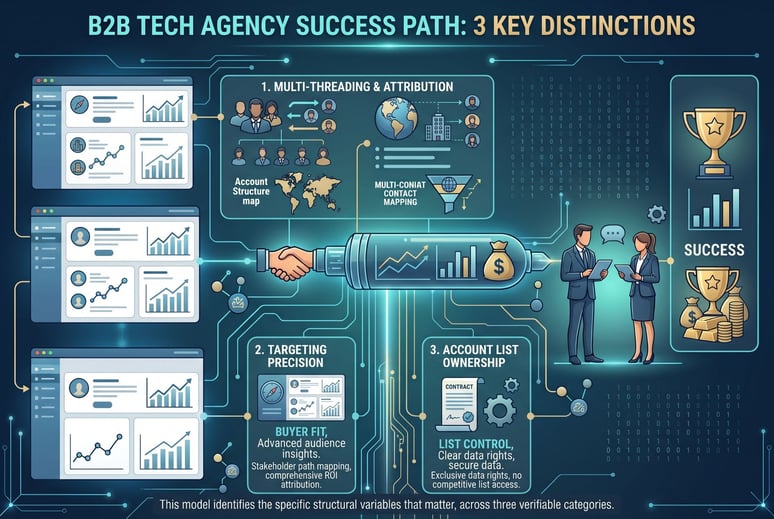
Buying committees in enterprise tech now average 13 stakeholders. That makes multi-threading a requirement rather than a refinement — an agency whose experience is single-contact outreach will build a sequence that reaches one person per account and stalls when that person needs internal support they can't generate alone.
Sales cycles run long enough that last-touch attribution misreads the channel entirely. LinkedIn tends to influence deals early, months before a demo request, and an agency that reports on last-touch will show you numbers that undercount its own work — or, more commonly, will report on leads instead and avoid the problem.
Technical buyers identify and discard generic messaging faster than almost any other audience. The tolerance for a template is close to zero, which raises the floor on research quality per account and lowers the viable volume.
For Israeli companies specifically, add the credibility problem, the US-versus-EU messaging split, and a working day that has to span Israel, the US East Coast, and Western Europe. Ask for evidence in the form of a sequence they wrote for a company in a comparable category — not a case study summary, the actual messages.
See also: The LinkedIn Lead Generation Benchmarks B2B SaaS Teams Should Track
Why Does CRM Capability Decide Whether You Can Audit Anything?
This is a buyer-protection question wearing technical clothing.
An agency working inside your HubSpot means lifecycle stages configured in your instance, a UTM structure agreed before any campaign launches, original source set on every contact they create, and SQL advancement logged by your sales team rather than theirs. Every claim in every monthly report can then be traced to a record you own.
An agency reporting from its own system means none of that. The monthly deck says 47 MQLs. Your CRM says something else, or says nothing, and reconciling the two becomes a quarterly argument nobody wins.
The consequence arrives at the end of the relationship. If the attribution history lives in their platform, you lose it when you leave — including the record of which campaigns, sequences, and account segments produced revenue, which is the single most valuable asset the engagement generated.
There's a quick way to test capability on a call. Ask how they would configure lifecycle stages for LinkedIn-sourced contacts, and listen for whether the answer contains specifics — scoring thresholds, workflow triggers, who advances a contact to SQL and on what basis. Vague answers here are not modesty.
See also: How to Connect LinkedIn Lead Generation to HubSpot Attribution
How Do You Compare Agency Proposals Fairly?
Three proposals in three pricing models cannot be compared as written. They have to be normalised first, and the normalisation is straightforward once you know what each model rewards.
|
Model |
Typical range |
What the fee covers |
What it incentivises |
Costs outside the invoice |
|
Monthly retainer |
3,000–15,000 SMB and mid-market; $20,000+ enterprise |
Strategy, list building, messaging, execution, reporting |
Consistency and iteration over time |
Ramp period before output; your time in onboarding and review |
|
Pay-per-lead |
200–500 per qualified lead |
Delivery of contacts meeting the agreed definition |
Volume against that definition |
Sales time spent disqualifying; CRM cleanup |
|
Pay-per-appointment |
200–1,000 per qualified meeting |
Booked meetings only |
Meetings that get scheduled |
No-shows; AE time on poor-fit calls |
|
Hybrid |
Reduced retainer plus performance component |
Varies — check the scope line carefully |
A balance of both |
Reconciliation overhead; disputed attribution |
Two columns do most of the work here. "What the fee covers" is why a $3,000 retainer and a $12,000 retainer are rarely buying the same thing — scope varies more than price does. And the last column is where the models genuinely separate: the invoice is comparable across all four, the sales time consumed is not, and it never appears in a proposal.
The normalisation: convert every proposal to projected cost per SQL, using your own historical MQL-to-SQL conversion rate rather than the agency's projection.
An $8,000 monthly retainer projecting 40 MQLs, at your actual 25% conversion rate, produces 10 SQLs — $800 per SQL. A pay-per-appointment model at $400 projecting 25 meetings, where a third don't progress past the first call, produces roughly 17 SQLs at $588 each. Those two proposals looked incomparable on arrival and are now a single decision.
One sanity check before any of that: a commonly cited demand-generation rule of thumb places CPL at 1–3% of average deal size. Run that against your ACV. A proposal quoting numbers far outside it is either mispriced or aimed at a different kind of company.
Whatever the model, negotiate the same pilot structure: 90 days, a defined and named account list, the SQL definition written into the agreement, and an exit without penalty at the end. An agency confident in its process will agree. One that requires a twelve-month commitment before producing anything is asking you to fund its learning curve.
Write Your SQL Definition Before You Take a Single Call
The selection is largely decided before the first conversation, by whether you can state what qualified means for your business. No agency can be held to a standard you haven't set, and any definition drafted by the vendor will be drafted to be achievable rather than useful. The agencies worth hiring will ask you for it in the first meeting — that request is itself a signal.
So before the calls: write the SQL definition, build the target account criteria, and pull your own MQL-to-SQL conversion rate from the last four quarters. Those three artifacts turn a vendor selection into a procurement exercise with a right answer, and all three become contract terms rather than assumptions.
Key takeaways
- An agency reporting in leads is asking you to carry the conversion risk. Ask for pipeline value and cost per SQL from past engagements. If they can only talk in lead volume, they've never been held to anything else.
- Three pricing models can't be compared as quoted. Convert every proposal to projected cost per SQL using your own conversion history, not the agency's projection. An $8,000 retainer and a $400-per-appointment deal become one decision.
- If the reporting lives in their dashboard, you can't verify any of it. Insist on lifecycle stages, UTM structure, and source attribution inside your own CRM — otherwise the engagement history leaves with them.
- Write your SQL definition before the first call. Any definition drafted by a vendor will be built to be achievable rather than useful, and it becomes a contract term either way.
|
Stop Guessing Why LinkedIn Isn't Delivering We'll pull apart your targeting, messaging, and tracking, and tell you which one is costing you the most.
|