



What to post, how to produce it in three hours a month, and how to tell whether it’s reaching the people who decide.
TL;DR: Founder content works because buyers in the US and Europe form a view of your company before anyone from your sales team speaks to them. A founder can give them a perspective they rarely get from company marketing: firsthand insight into the problem, the decisions, and the trade-offs. This article covers the content mix, the three-hour-a-month production system, how marketing supports it without flattening the voice, and how to measure whether any of it reaches your buying committees.
Your next buyer in Boston or Munich may never have heard of your company. Before anyone from your sales team reaches them, they’ll have formed some view of you — from a search, a peer, a post adjacent to your category. A LinkedIn content strategy for founders exists to occupy that window, and to help them understand the problem you solve, how you think about it, and why you’re worth a conversation.
The system behind it is simpler than most advice suggests. One recorded conversation a month: marketing asks what a customer objected to, what decision you made recently and why, what the last implementation taught you. Those answers become six to eight posts, which you review for accuracy and voice rather than polish. Around three hours of founder time a month, nearly all of it talking rather than writing.
What comes out of a session like that might be a post called “Why we advised a customer not to buy our product yet.” A real decision with its reasoning left in — which is what useful founder content looks like, and why it reaches people a case study never will.
Is Founder Content Worth a CEO’s Time
LinkedIn’s own Founder-Led Sales and Marketing Playbook associates consistent founder posting with 33% more leads, and reports deal sizes up to 3.7x higher and deal velocity 22% faster where prospects follow executives. Worth reading as correlation rather than mechanism — companies with founders posting consistently tend to differ in other ways too — but the direction is consistent enough to justify the time.
Deal size and velocity are the interesting ones since they point at deals already in your pipeline rather than at the top of the funnel. A buyer who has followed you for four months negotiates differently from one who met you last Tuesday.
On the buyer side, 76% of B2B buyers say they’d rather take a meeting with someone they already follow online. For an Israeli company whose name means nothing in its target market, that preference is the whole argument.
See also: How Israeli SaaS Companies Can Use LinkedIn to Reach US and EU Buyers
What Do Global Buyers Want to Hear From a Founder?
The 2025 Edelman-LinkedIn research introduced a useful piece of vocabulary: hidden buyers. These are internal influencers who shape or block a purchase, never appear on a sales call, and will not respond to outreach of any kind. They exist in every enterprise deal you’re working. Outbound rarely reaches them, and ads reach them only in the sense that an ad reaches everyone. Founder content has a better chance, because it arrives in a format they’ve chosen to consume.
A founder’s content reaches them. That’s the structural argument for doing this at all, and it’s a different argument from the lead-generation one — content isn’t competing with outbound, it’s covering the part of the committee outbound structurally cannot.
What those people consume is reasonably well documented. A LinkedIn survey of 1,716 B2B decision-makers across the US, UK and India found 59% consume creator content on LinkedIn — more than any other platform — with 79% engaging at least monthly and 82% saying it influences them. The creators they follow are industry experts at 55%, with analysts and business leaders tied at 43%.
The reading for a founder is that the role earning attention is practitioner, not executive. Posts written from the position of someone who has solved the problem outperform posts written from the position of someone who runs a company that solves it. The distinction sounds cosmetic and isn’t — one carries specifics the reader can use, the other carries a claim they’re asked to accept.
Selling into a market where you have no existing network puts a particular demand on the content. A buyer who found you through a post has no colleague to ask about you, so the content has to carry the familiarity a referral would normally supply. Three formats do that well: an implementation decision explained with its trade-offs, a direct answer to a support or compliance question buyers raise during evaluation, and a customer outcome with enough operating context that a reader can judge whether it resembles their situation.
|
Not Sure If Your Content Is Landing With the Right People? A review of your content, your reach, and who’s engaging with clear recommendations on what to improve first.
|

How Should You Split Product, Market Insight, and Customer Pain?
The most common failure in founder content is a founder who only posts about the product. It reads as a pitch delivered slowly, and it trains an audience to scroll past your name, which is an expensive thing to teach people.
A workable split runs roughly like this:
|
Content type |
Share |
What it does |
Where it comes from |
|
Customer pain |
~40% |
Signals you understand their week |
Your last three sales calls |
|
Market observation |
~20% |
Positions you as a reader of the category |
What changed this quarter |
|
Original point of view |
~30% |
Separates you from competitors |
An argument you’d defend publicly |
|
Product and company |
~10% |
Proof, not promotion |
A customer outcome, a launch |
The sourcing column is the part worth sitting with. Customer pain content doesn’t require research — it requires you to write down what someone said on a call on Tuesday. Founders routinely overlook this material because it’s familiar to them, and familiarity reads as obviousness from the inside. It isn’t obvious to a buyer who hasn’t had forty versions of that conversation.
One rule keeps the product slice honest: a post about your product should be readable by someone who will never buy it. If the only person who’d find it interesting is already in your pipeline, it belongs in an email, not on your feed.
And a note on what consumes the 10% without doing its job — funding announcements, hiring posts, and award news. Technical audiences discount all three almost completely. They’re fine occasionally for the people who already know you. They do nothing for the VP in Munich forming a first impression.
See also: AI-Assisted LinkedIn Prospecting: How to Find Better B2B Accounts Without Spamming People
How Do You Produce This in Three Hours a Month?
Here’s the principle the whole system rests on: founders do not write content. Founders talk, and someone else assembles. Writing is the bottleneck that kills these programmes, and it kills them specifically because writing is the part founders postpone when the week gets difficult, which is every week.
The system:
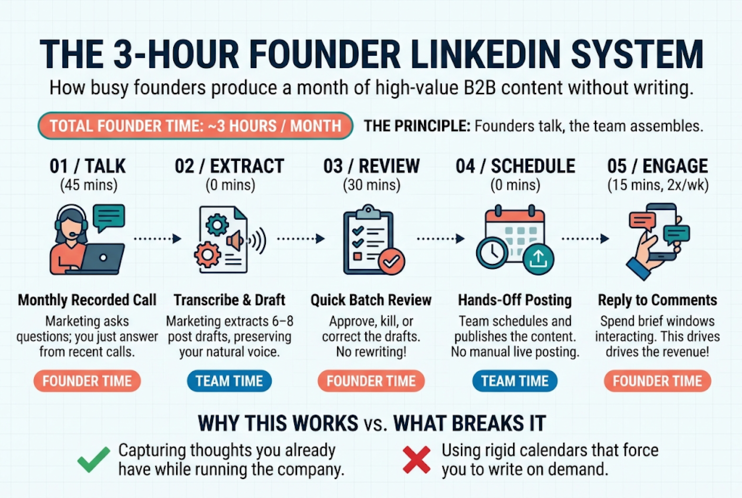
One 45-minute recorded conversation a month. Marketing asks questions, you answer from recent calls and whatever you’ve been thinking about. This is the only step requiring your full attention, and it’s a conversation rather than a performance — you’re not drafting, you’re talking the way you’d talk to a smart person who doesn’t work at your company.
Marketing extracts six to eight post drafts from the transcript, in your phrasing rather than theirs. This is editing, not writing, and the distinction determines whether the output sounds like you.
You review in one batch. Thirty minutes. Approve, kill, or correct. Not rewrite.
Posting is scheduled, not done live by you. Nobody needs the CEO opening LinkedIn at 9am to paste something in.
Fifteen minutes, twice a week, replying to comments. This is the only part that cannot be delegated, and the next section explains why it’s also the part that produces revenue.
Total founder time: roughly three hours a month. Programmes running on this model have operated on under two hours of founder time while producing posts, blog material and video clips from a single recorded session — the ratio is the point rather than the exact figure. Everything downstream of the recording is somebody else’s work.
What breaks this system is substituting a content calendar for the recording. The calendar approach requires a founder to generate thinking on demand against a schedule, which is the thing you have no capacity for. The recording approach captures thinking you already did this month in the course of running the company.
How Can Marketing Support a Founder Without Flattening the Voice?
The failure here is specific and predictable. A founder hands “make me look good on LinkedIn” to a marketer who has never run this play. Generic posts come back. The founder declines to publish them, correctly, because they don’t sound like anything. A few rounds of that and the programme quietly ends, with both parties privately concluding the other wasn’t committed.
Marketing’s job in this model is four things, none of which is writing from scratch.
Running the extraction interview. The questions determine the quality of everything downstream, and bad questions produce a transcript nothing can be built from.
Preserving phrasing. The founder’s actual words, including the ones that sound slightly wrong. Awkward phrasing is usually the distinctive part, and smoothing it is how a post ends up sounding like every other post.
Supplying the evidence. The data point, the customer example, the competitor claim the founder half-remembers from a call in March.
Handling distribution and measurement. Scheduling, Thought Leader Ad amplification of the posts that perform, and the reporting covered below.
The question set is the practical asset here, because it’s what makes a 45-minute recording produce eight posts instead of eight minutes of nothing:
- What did a customer say this month that surprised you?
- What do most people in our category believe that you think is wrong?
- What question keeps coming up on sales calls?
- What did you change your mind about this year?
- What’s the thing you’d warn a buyer about even though it costs us deals?
That last one produces the best posts and the most founder hesitation, which is usually a signal it’s worth publishing.
One rule protects velocity: the founder edits for accuracy and voice, not for polish. A post edited four times stops sounding like a person. Two passes maximum, then it ships.
The same extraction model works for a VP of Engineering or a Head of Customer Success, and a second voice compounds reach without costing the founder additional time — worth doing once the first programme is running, not before.
See also: Why Most LinkedIn Outreach Fails and How B2B Tech Companies Should Fix It
How Does Founder Content Become a Sales Conversation?
This is the transition most programmes never build, which is why founder content gets written off as brand activity in the board meeting where someone asks what it produced.
The mechanics run in sequence. A post publishes and accounts engage. Marketing or an SDR identifies which engagers sit inside your named account list — the signal is who engaged, not how many. Outreach then references that specific exchange, and does so within 24 hours, because the warming effect decays measurably over days rather than weeks.
The founder handles replies in-thread. Sales handles the move to a call. That separation is the rule that keeps the whole thing working, and the moment a founder’s comment reply contains a calendar link, the content stops being content and becomes an ad with extra steps. Readers detect the change immediately and engagement drops away.
The reason this is worth building is that engaged accounts are measurably the best outreach list you have access to. 90% of decision-makers say they’re more receptive to outreach from companies that consistently publish quality thought leadership, meaning the people who read your post last Thursday are a warmer audience than anything your filters will assemble.
Just remember: none of this functions unless the engagement data reaches your CRM.
See also: How to Connect LinkedIn Lead Generation to HubSpot Attribution
How Do You Measure Whether It’s Reaching the Right People?
The measurement problem with founder content is that the available numbers arrive immediately and mean nothing, while the meaningful ones take a quarter to register. Impressions and reactions are visible the morning after. Target account engagement takes 90 days to become readable as a trend.
Four things worth reporting:
Target account engagement rate. What share of your named account list has engaged with founder content in the last 90 days. This is the primary number, because it directly measures whether you’re reaching the committees you’re selling into rather than an audience of peers and competitors.
Acceptance and reply lift on outreach to engaged versus non-engaged accounts. This is the figure that proves the mechanism to a sceptical VP Sales, and it requires only a segment comparison in HubSpot.
Inbound meetings referencing content. Ask on every discovery call where they first came across the company. The answers won’t be in any dashboard and they’re the most reliable signal you’ll get.
Deal size and velocity on engaged accounts, measured against the 3.7x and 22% figures above.
Stop reporting follower count, impressions, and reactions. They move independently of everything that produces revenue, and reporting them invites the board to evaluate the programme on numbers that don’t connect to pipeline.
The timeline to set expectations against: 90 days before outreach conversion shifts measurably, six months before inbound arrives without prompting.
Start With a Recording, Not a Calendar
The founder content programmes that collapse are the ones that begin with a posting schedule, because a schedule asks a founder to generate thinking on demand and that capacity doesn’t exist alongside running a company. The ones that survive begin with a recorded conversation and a question set, because those capture thinking that already happened in the course of the month.
Book 45 minutes this month. Have someone record it, ask the five questions above, and extract eight posts from the transcript. That costs less than the time already spent deciding whether founder-led content is worth doing, and it produces something you can judge on evidence rather than on principle.
Key takeaways
- Founder content reaches the buyers your sales team can’t. Hidden buyers shape or block enterprise deals and rarely respond to outreach. Founder content is one of the few formats that reaches them, because they’ve chosen to consume it.
- Founders talk, someone else writes. One 45-minute recorded conversation a month produces six to eight posts. A content calendar asks you to generate thinking on demand, which is why calendar-based programmes die by week six.
- Split roughly 40/20/30/10 — customer pain, market observation, original point of view, product. A post about your product should be readable by someone who will never buy it.
- Report target account engagement, not impressions. The number that proves the mechanism is acceptance and reply lift on outreach to accounts that engaged with founder content versus those that didn’t.
|
Is Your LinkedIn Activity Reaching the Right Buyers? Get a review of your content, outreach, and engagement from target buyers — with clear recommendations on what to improve first.
|